Are Marine Fuel and Oil Filters the Same?
If you have ever looked at the filters fitted to a marine diesel engine and thought, “These look almost identical—are fuel and oil filters actually the same?”, you are not alone.
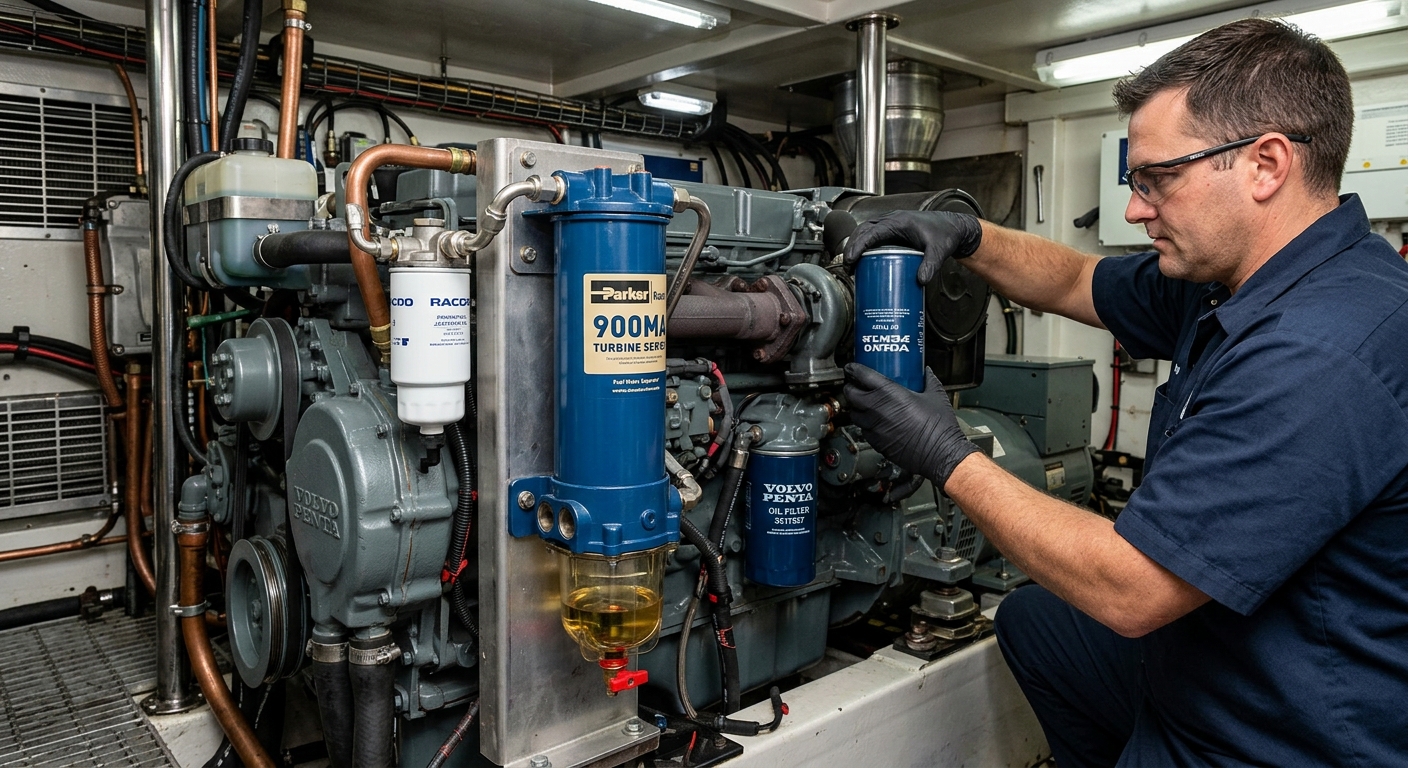
It is an understandable question. Many marine fuel and oil filters are cylindrical, use a spin-on design and can even be similar in size.
But the answer is simple:
No, marine fuel filters and oil filters are not the same.
A fuel filter cleans the diesel going into the engine's fuel system. An oil filter cleans the lubricating oil circulating inside the engine.
They protect completely different systems, and one should not be substituted for the other simply because it looks like it will fit.
Let's look at the difference and answer some of the questions we regularly see when identifying filters for Caterpillar, MTU, Cummins, Volvo Penta, MAN, Deutz, Perkins, Yanmar and other marine diesel engines.
What Is the Difference Between a Marine Fuel Filter and Oil Filter?
Think about it this way.
Your fuel filter protects what goes into the combustion system.
Your oil filter protects the engine while everything inside it is moving.
A fuel filter removes unwanted contamination from diesel before the fuel reaches components such as the fuel pump and injectors.
An oil filter removes contamination from lubricating oil as the oil circulates through the engine.
| Marine Fuel FilterMarine Oil Filter | ||
| Filters | Diesel fuel | Engine oil |
| Main job | Protect fuel system | Protect lubrication system |
| Protects | Fuel pumps, injectors and related components | Bearings, crankshaft, turbocharger and other lubricated components |
| Typical contamination | Dirt, sediment, rust, water | Soot, wear particles and deposits |
| Same filter? | No | No |
The important point is that looking similar does not mean working the same way.
Why Do Fuel and Oil Filters Look So Similar?
This is probably where most of the confusion comes from.
Imagine you remove two filters from a marine engine. Both are metal cylinders. Both are approximately the same diameter. Both screw onto a filter head.
It is tempting to think:
“If the thread fits, why can't I use this one?”
Because physical fit is only one part of filter compatibility.
Inside the filter, things can be very different.
Filters are designed around factors such as filtration media, flow requirements, pressure conditions, seals, internal construction and the fluid being filtered.
So a filter screwing onto the engine does not prove that it belongs there.
Can I Use a Fuel Filter as an Oil Filter?
No—not simply because it fits.
Unless the manufacturer specifically approves that exact filter reference for the application, don't substitute a fuel filter for an oil filter.
The same applies the other way around.
An oil filter that physically screws onto a fuel-filter head is still an oil filter.
This is why we always recommend identifying marine filters by part number and engine information, rather than dimensions alone.
A Good Caterpillar Example: 1R-0749 vs 1R-1808
Caterpillar gives us a very clear real-world example.
Take these two filters:
Caterpillar 1R-0749 / 1R0749
The Caterpillar 1R-0749 / 1R0749 is a secondary fuel filter.
It is used across selected Caterpillar applications, including marine engine applications within families such as:
- Caterpillar C12
- Caterpillar C15
- Caterpillar C18
- Caterpillar C30
- Caterpillar C32
- Caterpillar 3196
- Caterpillar 3406
- Caterpillar 3408
- Caterpillar 3412
Now compare that with another familiar Caterpillar filter.
Caterpillar 1R-1808 / 1R1808
The Caterpillar 1R-1808 / 1R1808 is an engine oil filter.
It is also found across selected Caterpillar marine applications, including engines within the C18, C32, 3406, 3408 and 3412 families.
So we have two filters from the same manufacturer that can appear across some of the same engine families:
1R-0749 / 1R0749 = Fuel Filter
1R-1808 / 1R1808 = Engine Oil Filter
They are not interchangeable just because both are filters or because they may be associated with the same general engine family.
This is exactly why checking the part number matters.
What About Other Caterpillar Filter Part Numbers?
Caterpillar has many different filtration components.
Examples customers may come across include:
| Part NumberDescription | |
| 1R-0749 / 1R0749 | Secondary Fuel Filter |
| 1R-1808 / 1R1808 | Engine Oil Filter |
| 244-4484 / 2444484 | Engine Oil Filter |
| 360-8960 / 3608960 | Fuel Filter Element |
| 326-1643 / 3261643 | Fuel/Water Separator Filter Assembly |
These are good examples of why asking for “a Caterpillar marine filter” isn't enough information.
We need to know what you are filtering.
Does a Caterpillar C18 Use the Same Fuel and Oil Filter?
No.
Selected Caterpillar C18 marine engine applications can use 1R-0749 / 1R0749 for fuel filtration and 1R-1808 / 1R1808 for engine-oil filtration.
But there is another important point here.
Don't assume that every Caterpillar C18 automatically uses the same filters.
C18 configurations can differ according to serial number and arrangement.
If you are ordering filters for a C18, the safest information to provide is:
Engine model + complete serial number + serial-number prefix + arrangement number + existing filter part number
That allows the filter to be checked against the actual engine rather than simply guessing from “C18.”
What About Caterpillar C32 Filters?
The same rule applies to the Caterpillar C32 marine engine.
Selected C32 applications are associated with both 1R-0749 and 1R-1808, but they serve different systems.
Again:
1R-0749 = Fuel
1R-1808 = Oil
If somebody asks us for a “C32 filter,” our next question should be:
Which filter?
Fuel? Oil? Fuel/water separator? Air? Another filtration component?
The engine model by itself doesn't tell the whole story.
What Is a Marine Fuel/Water Separator?
Here's another question that often causes confusion:
Is a fuel/water separator just another fuel filter?
It is part of the fuel-filtration system, but its job includes something particularly important on boats: removing water from diesel fuel.
Water can find its way into marine fuel tanks through contaminated fuel, condensation and other sources.
Many vessel installations therefore use a fuel/water separator before the fuel reaches the engine-mounted filters.
A simplified system might look something like this:
Fuel Tank → Fuel/Water Separator → Secondary Fuel Filter → Fuel Pump → Injectors
The exact setup depends on the vessel and engine.
Does a Marine Engine Have More Than One Fuel Filter?
Quite often, yes.
Many marine installations use more than one stage of fuel filtration.
The first stage may remove larger contamination and separate water.
A secondary engine-mounted filter then provides another filtration stage before the fuel reaches sensitive fuel-system components.
So if your engine has two or three fuel-related filters, that doesn't necessarily mean someone has installed unnecessary filters.
They may each have a specific role.
Which Filter Protects the Injectors?
The fuel filtration system protects the injectors.
This becomes especially important with modern diesel injection systems, where very small contaminants can cause expensive problems.
Good fuel filtration helps protect components such as:
Fuel pumps → high-pressure fuel equipment → injectors
This is also why choosing an incorrect fuel filter just because it physically fits is a bad idea.
The cost of the filter is small compared with the cost of repairing a damaged injection system.
Which Filter Protects the Turbocharger?
This question is slightly different.
The turbocharger's bearings are normally lubricated by the engine's lubricating-oil system.
That means the engine oil and oil filtration system contribute to protecting the turbocharger bearings along with many other lubricated engine components.
Clean oil, correct oil pressure and proper oil maintenance are all important.
Again, the oil filter and fuel filter are doing very different jobs.
What About MTU Marine Fuel and Oil Filters?
The same principle applies to MTU marine diesel engines.
MTU families such as:
Series 2000
Series 4000
Series 1163
Series 8000
use dedicated fuel and lubricating-oil filtration systems.
If you're ordering parts, simply saying “I need an MTU 4000 filter” isn't enough.
For example, we would want to know:
Is it a fuel filter?
A fuel prefilter?
A lube oil filter?
A replacement filter element?
Or a complete filter assembly?
We would also want the complete engine designation and serial number.
An MTU 16V 4000 M90, for example, should not automatically be treated as having the same filtration arrangement as every other engine carrying the Series 4000 name.
Are Cummins Marine Fuel and Oil Filters Different?
Yes.
Cummins marine engines also use separate fuel and lubricating-oil filtration systems.
This applies across familiar marine engine families such as:
Cummins QSB, QSC, QSL, QSM11, KTA19, KTA38, KTA50, QSK19, QSK38, QSK50 and QSK60.
Cummins filtration is also commonly associated with Fleetguard products.
If you're trying to identify a Cummins marine filter, one of the most useful pieces of information you can provide is the Engine Serial Number (ESN).
Don't assume every QSK50 or KTA38 uses exactly the same filters simply because the engine family matches.
What About Volvo Penta Filters?
Volvo Penta marine engines also use separate filters for fuel and engine oil.
Depending on the vessel installation, you may find an additional primary fuel/water separator installed before the engine-mounted fuel filter.
When identifying a Volvo Penta filter, use the:
Engine model + serial number + existing filter reference
rather than simply matching the physical size.
Are MAN Marine Fuel and Oil Filters the Same?
No.
MAN marine engines also have dedicated fuel and lubricating-oil filtration systems.
On larger engines, filtration arrangements can be much more complex than the familiar small spin-on filter.
If you are requesting MAN filtration parts, make it clear whether you need a:
Fuel filter • fuel filter element • lube oil filter • prefilter • complete filter assembly
The complete MAN engine type and existing filter reference can make identification much easier.
What About Deutz Marine Filters?
Deutz marine and auxiliary diesel engines also use separate filtration systems for diesel fuel and lubricating oil.
This can apply across engine families such as:
Deutz 413
Deutz 912
Deutz 1013
Deutz 1015
Deutz TCD 2013
Again, don't choose the replacement filter simply because it looks the same.
Check the engine type, serial number and existing part number.
Perkins Marine Fuel vs Oil Filters
The same rule applies to Perkins and Perkins Sabre marine engines.
A Perkins fuel filter protects the fuel system.
A Perkins oil filter protects the lubrication system.
The vessel may also have a separate fuel/water separator installed before the engine's own filtration system.
If you don't know which filter you have, send the engine model, serial number and filter number rather than guessing.
Yanmar Marine Fuel vs Oil Filters
Yanmar marine diesel engines also use dedicated fuel and engine-oil filters.
This is particularly useful to remember on smaller marine engines because the filters can be physically small and may look deceptively similar.
The safest approach is still the simplest:
Read the part number before removing or replacing the filter.
Can I Use an Automotive Filter on a Marine Diesel Engine?
Sometimes filters or related engine components may share applications across marine, industrial and other engine installations.
But don't assume an automotive filter is suitable simply because it has the same dimensions.
The correct replacement should be confirmed using the manufacturer's specified part number or a properly verified cross-reference.
This matters even more on engines that spend long periods operating under continuous marine load.
Can I Cross-Reference a Marine Filter to Another Brand?
Yes, in many cases.
A genuine OEM filter may have documented equivalents from established filtration manufacturers.
But a cross-reference needs to be checked properly.
A website saying “this looks similar to 1R-0749” isn't enough.
The replacement filter needs to meet the required specifications for the application.
How Often Should I Change My Marine Fuel Filter?
There isn't one answer for every engine.
A small Yanmar auxiliary engine and a large MTU Series 4000 propulsion engine obviously don't have identical maintenance requirements.
Fuel-filter replacement depends on factors including:
- Engine model
- Manufacturer's maintenance schedule
- Operating hours
- Fuel quality
- Fuel contamination
- Installed filtration system
- Operating environment
If you suddenly find significant water or contamination in the fuel system, don't simply wait for the next scheduled filter change.
Investigate why it is happening.
How Often Should I Change My Marine Oil Filter?
Again, follow the maintenance schedule for your specific engine.
Oil-filter servicing is normally associated with the engine's lubrication maintenance, but intervals vary between manufacturers, engine models and operating conditions.
Don't use a generic internet rule such as “change every marine oil filter after X hours” across every engine.
Check the actual engine documentation.
Can a Blocked Fuel Filter Cause Power Loss?
Yes, a restricted fuel filter can contribute to insufficient fuel supply, which may show up as problems such as difficulty reaching rated power or unstable engine operation.
But don't immediately blame the filter.
Similar symptoms can also involve fuel pumps, injectors, fuel lines, tank contamination, air entering the system or other engine problems.
Think of the fuel filter as one part of the diagnosis.
Can a Bad Oil Filter Cause Low Oil Pressure?
Lubrication-system problems need careful diagnosis.
If you're seeing abnormal oil pressure or an oil-pressure alarm, don't automatically assume the oil filter is the cause.
Check the complete lubrication system, including:
Oil level • oil condition • correct oil specification • filter • oil pump • pressure sensor • relief system • internal engine condition
Low oil pressure can be serious, so it should be investigated properly.
How Do I Know Which Marine Filter I Need?
This is actually easier than many people think.
Before ordering, take a clear photo of the existing filter and write down the number printed on it.
Then collect:
Engine manufacturer
Complete engine model
Engine serial number
Existing filter part number
Whether you need fuel or oil filtration
Required quantity
For Caterpillar engines, also provide the serial-number prefix and arrangement number where available.
For Cummins, provide the Engine Serial Number (ESN).
For MTU, provide the complete engine designation and serial number.
That is much safer than saying:
“I need the big white filter from my engine.”
So, Are Marine Fuel and Oil Filters the Same?
No—and that's the main takeaway.
They may look similar.
They may both screw onto an engine.
They may even be manufactured by the same company and appear on the same engine family.
But they protect completely different systems.
A simple Caterpillar example makes the difference easy to remember:
Caterpillar 1R-0749 / 1R0749 → Fuel Filter
Caterpillar 1R-1808 / 1R1808 → Engine Oil Filter
Don't identify a marine filter by appearance.
Identify it by part number, engine model and serial number.
Need Help Identifying a Marine Fuel or Oil Filter?
Marine filter requirements can include:
Fuel filters • fuel/water separators • secondary fuel filters • oil filters • lube oil filter elements • filter housings • seals • O-rings
We support filtration requirements for marine diesel engines including Caterpillar, MTU, Cummins, Volvo Penta, MAN, Deutz, Perkins, Yanmar, Detroit Diesel and Scania.
When requesting a quotation, send:
Engine model + serial number + existing filter part number + quantity + delivery destination
Email: request@alfamarinespareparts.com
Frequently Asked Questions
Are marine fuel filters and oil filters interchangeable?
No. They are designed for different fluids and different engine systems. Never substitute one simply because it physically fits.
Is Caterpillar 1R-0749 a fuel filter?
Yes. Caterpillar 1R-0749 / 1R0749 is a secondary fuel filter.
Is Caterpillar 1R-1808 an oil filter?
Yes. Caterpillar 1R-1808 / 1R1808 is an engine oil filter.
Can I replace 1R-0749 with 1R-1808?
No. 1R-0749 is used for fuel filtration, while 1R-1808 is used for engine-oil filtration. They should not be treated as interchangeable.
Why do fuel and oil filters sometimes look identical?
Many use similar spin-on metal housings. The important differences are inside the filter, including the filtration media and application specifications.
Does every Caterpillar C18 use the same filters?
No. Filter requirements can depend on the individual engine arrangement and serial number. Always verify the engine before ordering.
Does every Caterpillar C32 use 1R-0749 and 1R-1808?
Do not assume so. These references are associated with selected C32 applications, but the individual engine should be verified using its serial number and arrangement.
Is a fuel/water separator the same as an oil filter?
No. A fuel/water separator is part of the fuel system and helps remove water and contamination from diesel fuel.
Can a marine engine have two fuel filters?
Yes. Many marine fuel systems use multiple filtration stages, often including a primary fuel/water separator and a secondary engine-mounted fuel filter.
Can I use a cheaper replacement filter?
A quality replacement or cross-reference may be available, but compatibility and specifications should be verified against the original filter and engine application.
What information do I need when ordering a marine filter?
Ideally provide the engine manufacturer, complete model, serial number, existing filter part number and required quantity.