
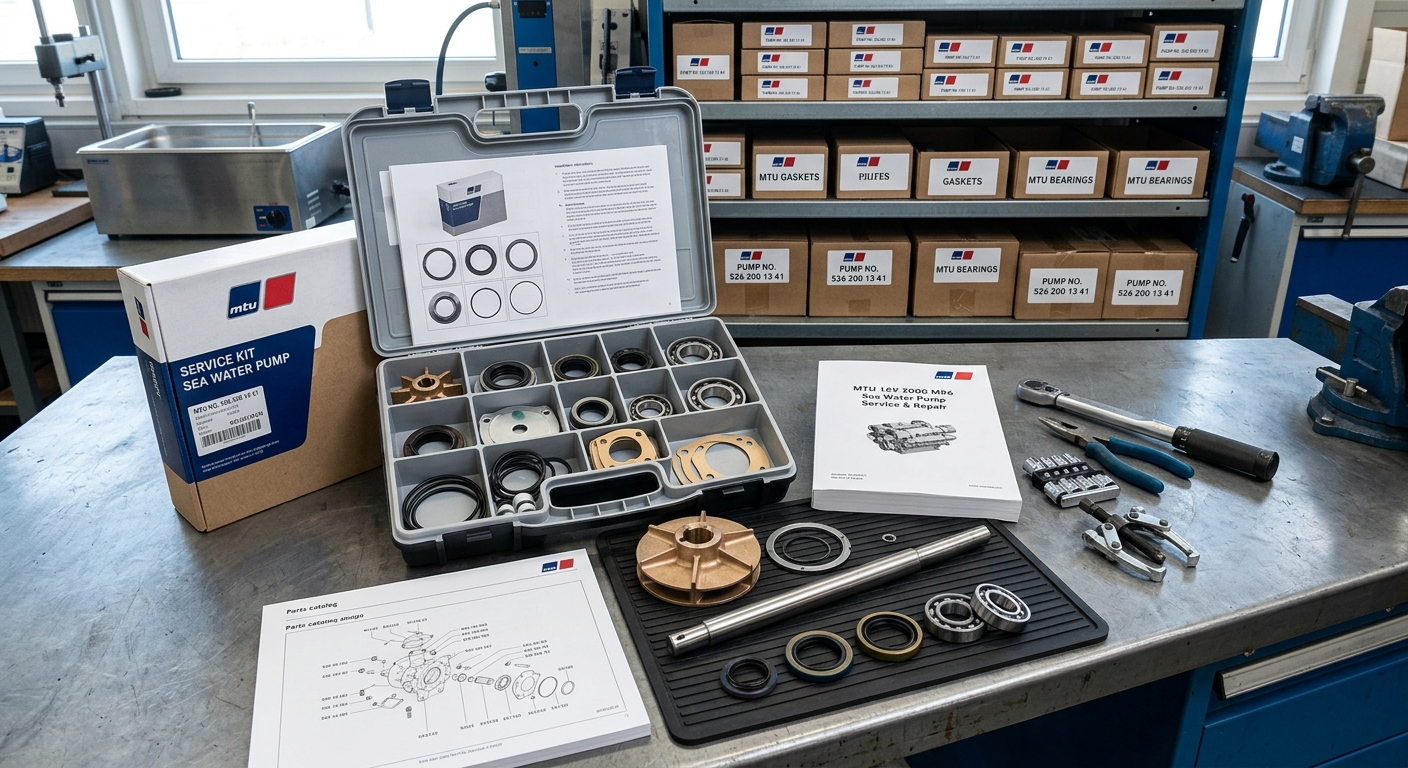
MTU Sea Water Pump Repair Kit: What Parts Do You Actually Need?
If your MTU sea water pump is leaking, making noise or no longer providing the cooling-water flow you expect, you may start searching for:
“MTU sea water pump repair kit.”
Sounds simple enough.
But then you start seeing kits advertised for MTU Series 2000, others for MTU Series 4000, different seals, bearings, shafts and pump designs.
So which one actually fits your engine?
That's where things can get confusing.
The most important thing to understand is this:
There isn't one universal MTU seawater pump repair kit.
Before ordering anything, start with:
Complete MTU engine model + engine serial number + existing seawater pump part number
If the pump has already been removed, don't dismantle it immediately.
First, photograph it.
Record every number you can find.
Those old markings may be exactly what you need to identify the correct repair parts.
You can also browse our marine spare-parts catalog or request a quotation if you already have the pump or repair-kit reference.
What Exactly Is an MTU Sea Water Pump Repair Kit?
Think of it as a collection of components used to service or rebuild a particular seawater pump.
Depending on the pump, a repair may involve components such as:
- Seals
- O-rings
- Gaskets
- Bearings
- Shaft-related components
- Sealing rings
- Wear components
- Other internal pump parts
But here's the important part:
Not every kit contains the same components.
A kit advertised online as an:
“MTU water pump repair kit”
doesn't automatically contain everything required to rebuild your particular pump.
You need to know which pump you have first.
Sea Water Pump, Seawater Pump or Raw Water Pump: Are They the Same Thing?
You'll see all three terms when searching for marine engine parts:
Sea water pump
Seawater pump
Raw water pump
In marine-parts searches, people often use these terms for the pump handling outside cooling water.
MTU technical information also uses raw water pump terminology for applicable marine cooling-system arrangements.
So if you're searching online, it can make sense to search all three phrases.
But terminology isn't the most important thing.
The pump part number is.
Is the MTU Sea Water Pump the Same as the Coolant Pump?
No.
This is an easy mistake to make.
The seawater/raw-water side and the engine coolant side perform different jobs within the cooling system.
In a simplified arrangement, seawater can be drawn from outside the vessel and circulated through cooling components.
The coolant circuit circulates engine coolant through the engine's internal cooling system.
So if somebody asks:
“I need an MTU water pump.”
our next question should be:
“Which water pump?”
Sea water/raw water?
Or engine coolant?
That distinction matters before you start looking at part numbers.
Do All MTU Sea Water Pumps Use the Same Design?
No.
And this is particularly important when you're buying repair parts.
MTU documentation for multiple Series 2000 and Series 4000 marine applications describes a self-priming centrifugal raw-water pump.
That means you should not automatically assume every MTU seawater pump is a flexible-impeller pump.
Different engines and installations still need to be identified individually.
So if somebody offers you:
“One MTU Series 2000 impeller kit — fits all”
don't order it based on that description alone.
Identify the actual pump.
What's the First Number I Should Look For?
The existing seawater-pump part number.
Before cleaning or dismantling the pump, look carefully for:
Identification plate
Stamped numbers
Engraved references
Manufacturer markings
Prefixes
Suffixes
Leading zeros
Take photographs.
And don't shorten the number because part of it looks unnecessary.
If the pump says:
00XXXXXXXXXX
record the complete reference exactly as you find it.
One missing zero or suffix can turn a useful parts search into a guessing game.
Why Isn't “MTU Series 2000 Pump Kit” Enough?
Because Series 2000 is an engine family, not one single engine and pump configuration.
A search for:
MTU Series 2000 seawater pump repair kit
is better than searching only:
MTU pump kit
but it still may not be specific enough.
A much stronger identification package is:
Exact MTU Series 2000 engine model + engine serial number + seawater pump part number
The same applies to the Series 4000.
Don't assume that two engines use the same seawater pump simply because both say Series 2000 or Series 4000.
What About MTU Series 2000 Sea Water Pump Repair Kits?
If you're working with an MTU Series 2000 engine, start with the complete engine designation.
Don't stop at:
MTU 2000
The Series 2000 family contains numerous engine configurations.
Then record:
Engine serial number
and, most importantly for the repair-kit search:
Existing pump part number
That gives you a much better chance of identifying the correct:
Seal
Bearing
Shaft component
Repair kit
or
Complete replacement pump
You can browse marine engine and cooling-system parts if you already know the component you require.
And What About MTU Series 4000 Pump Repair Kits?
Exactly the same rule applies.
A listing saying:
“MTU 4000 sea water pump repair kit”
doesn't automatically mean it fits every MTU Series 4000 marine engine.
Instead, use:
Complete Series 4000 engine designation + engine serial number + existing pump part number
before confirming the repair components.
This becomes even more important when you're dealing with older pump references, superseded numbers or replacement components.
Why Does the Engine Serial Number Matter?
Because the complete engine identification helps narrow down the actual application.
For an MTU pump enquiry, a good starting package is:
Complete engine model
Engine serial number
Existing pump part number
The serial number is important, but don't rely on the engine serial number alone when the pump itself has identification available.
For a repair kit, the pump's own part number can be particularly valuable.
I Already Know My Pump Number. What Should I Search?
Good.
Now your search becomes much more specific.
Instead of:
MTU seawater pump kit
search:
MTU + pump part number + repair kit
Even better:
Exact MTU engine model + pump part number + repair kit
If you find a proposed repair-kit reference, record both numbers:
Pump part number + proposed repair-kit part number
Then verify that relationship before ordering.
Does an MTU Sea Water Pump Repair Kit Always Include an Impeller?
No.
This is one of the biggest misconceptions around marine water-pump repair kits.
People hear “raw water pump” and immediately think:
rubber flexible impeller.
But that isn't something you should assume for every MTU pump.
MTU documentation for multiple Series 2000 and Series 4000 marine applications identifies self-priming centrifugal raw-water pumps.
So don't buy a flexible impeller simply because the engine is marine and the pump handles seawater.
First identify the pump design.
Then identify the required components.
What If My Specific Pump Does Use a Flexible Impeller?
Then the situation is different.
If the identified pump actually uses a flexible impeller, inspect the removed component carefully.
Look for:
- Cracks
- Missing vanes
- Permanent deformation
- Heat damage
- Surface deterioration
- Excessive wear
But this advice applies only where the actual pump uses that design.
It shouldn't be applied universally to every MTU seawater pump.
My Flexible Impeller Has Missing Vanes. Can I Just Install Another One?
Not without investigating where the missing material went.
If pieces have broken away, they can potentially travel downstream with the seawater flow.
So don't simply fit a new impeller, close the pump and assume the job is finished.
Inspect the applicable downstream passages and cooling components as required.
You don't want pieces of the old impeller remaining somewhere in the cooling circuit.
My MTU Sea Water Pump Is Leaking. Do I Just Need a Seal Kit?
Maybe.
But don't automatically order seals before inspecting the pump.
A leaking pump can involve the sealing components, but you should also consider the condition of:
Shaft
Sealing surface
Housing
Bearings
Gaskets
O-rings
If the shaft is badly worn where the seal runs, installing another new seal may not solve the underlying problem.
Why Should I Inspect the Pump Shaft?
Because a new seal needs an acceptable surface to work against.
If the shaft or sealing area has:
- Wear
- Corrosion
- Surface damage
- Excessive play
- Other deterioration
then replacing only the seal may not produce a satisfactory repair.
That's why a proper pump rebuild isn't simply:
old seal out → new seal in → finished.
Inspect the related components too.
Should I Replace the Bearings While the Pump Is Apart?
That depends on the particular pump design, repair scope and bearing condition.
Where the pump incorporates serviceable bearings, check for signs such as:
Excessive play
Rough rotation
Binding
Abnormal noise
Water ingress
Corrosion
Don't install new seals and ignore a bearing that's obviously in poor condition.
The purpose of opening the pump is to understand what actually needs attention.
What About the Pump Housing?
Inspect that too.
Seawater isn't particularly kind to machinery over long periods.
Depending on the pump, look for:
- Corrosion
- Erosion
- Cracks
- Excessive wear
- Damaged sealing surfaces
- Internal damage
A repair kit can replace service components.
It cannot magically repair a pump housing that is no longer serviceable.
Should I Repair the Pump or Buy a Complete Replacement?
That's a very practical question.
A repair kit may make sense when:
The pump has been positively identified
The necessary repair components are available
The damage is within a reasonable repair scope
The main pump components remain serviceable
A complete pump may make more sense when you find significant:
Housing damage
Shaft damage
Severe corrosion
Cracking
Excessive internal wear
Multiple damaged components
Parts availability matters too.
Sometimes rebuilding makes perfect sense.
Sometimes the cost and complexity of repairing a badly damaged pump makes replacement the better option.
Inspect first.
Decide second.
My MTU Engine Has Low Seawater Flow. Does That Mean the Pump Is Bad?
Not necessarily.
This is another common mistake.
Low seawater flow can come from several places in the system.
Depending on the vessel, you may need to check:
Sea intake
Seacock
Sea strainer
Suction hoses
Suction piping
Air leaks
Seawater pump
Heat exchangers
Coolers
Discharge restrictions
Marine growth
The pump is only one part of the seawater circuit.
What Does the Seawater Circuit Look Like?
A simplified arrangement might look like:
Sea intake → seacock → sea strainer → seawater pump → cooling components → discharge
The actual routing depends on the engine and vessel.
But this simple layout explains something important:
A perfectly rebuilt pump cannot overcome a badly restricted water supply.
If the strainer is blocked or the seacock isn't fully open, rebuilding the pump won't solve that restriction.
Can a Blocked Sea Strainer Cause Overheating?
Yes, a restricted sea strainer can reduce the amount of seawater reaching the pump.
That's why the strainer is one of the basic areas to inspect when investigating poor seawater flow.
Imagine spending money rebuilding the pump, reinstalling it and then discovering the real problem was upstream.
That's exactly the kind of unnecessary work good diagnosis can prevent.
Should I Check the Seacock After Pump Repair?
Absolutely.
Seawater valves are often closed during maintenance.
Before returning the engine to normal operation, confirm that the applicable valves are back in their correct operating positions.
A closed or partially closed seacock can restrict water supply regardless of how good the pump is.
What About the Suction Hose?
Check it.
A pump needs a proper inlet supply.
Inspect applicable suction hoses and connections for:
Loose connections
Damaged hoses
Collapsed hoses
Restrictions
Corrosion
Air entry
A problem on the suction side can make a good pump appear to be a bad pump.
Can the Restriction Be After the Pump?
Yes.
Don't inspect only the intake side.
Depending on the engine and installation, seawater may flow through components such as:
Heat exchangers
Charge-air cooling components
Oil coolers
Gearbox coolers
Connecting pipework
If one of those areas is restricted, cooling performance can remain poor even after the pump has been rebuilt.
I Rebuilt the Pump but the Engine Still Overheats. What Now?
Don't immediately assume the rebuilt pump is defective.
Overheating can have multiple causes.
You may need to investigate:
Seawater supply
Sea strainer
Pump operation
Heat exchangers
Coolers
Coolant circulation
Thermostatic components
System restrictions
and other engine-specific cooling conditions.
The seawater pump is important.
It isn't the entire cooling system.
The Pump Is Leaking Again After Repair. What Should I Check?
First, determine where the leak is actually coming from.
Depending on the pump design, investigate:
Seal installation
Shaft condition
Gasket installation
O-ring installation
Housing condition
Fastener installation
Sealing surfaces
Don't respond to every leak by simply tightening everything harder.
Find the cause.
What Should I Check After Reinstalling the Pump?
Before placing the engine under significant load, check the system carefully.
Look for:
Correct valve positions
Leaks
Seawater circulation
Abnormal pump noise
Correct temperature behaviour
Secure connections
Reinstalling the pump isn't the end of the repair.
Confirm that the complete system is operating correctly.
My MTU Pump Has an Old Part Number. Is It Still Useful?
Yes.
Keep that number.
An older pump reference can be extremely useful for:
Pump identification
Repair-kit searches
Supersession research
Cross-reference checks
Supplier enquiries
Don't remove an old identification plate or discard an old pump before recording the reference.
For legacy marine components, an old number can sometimes be more useful than a photograph.
Can an Old MTU Pump Number Have a New Replacement Number?
Yes, component references can change or be superseded.
You may encounter something like:
Old pump number → newer pump reference
or:
Old repair-kit number → proposed replacement kit
But don't assume a supersession or cross-reference is automatically correct for every configuration.
When checking it, provide:
Old pump number + proposed new number + complete engine model + engine serial number
Can I Use an Aftermarket MTU Pump Repair Kit?
Potentially, where an alternative is acceptable and the kit is properly matched to the pump.
But a cross-reference isn't enough by itself.
Verify:
Exact pump
Repair-kit reference
Kit contents
Repair scope
Required components
If genuine/OEM components are mandatory, state:
OEM required
Don't assume that the word “new” means OEM.
New simply describes condition unless the manufacturer and supply source are confirmed.
Can I Buy the Seal, Bearing or Shaft Separately?
Depending on the pump and parts availability, individual repair components may be available separately.
That can be useful when you don't require a complete repair kit.
But again, identify the pump first.
For example, don't order a shaft because someone tells you:
“This is an MTU Series 2000 pump shaft.”
You want to know:
Which Series 2000 engine?
Which pump?
Which pump reference?
Which shaft reference?
That's the level of identification that reduces expensive mistakes.
I Don't Have the Pump Part Number. Can Photographs Help?
Yes.
If you can't find a readable reference, send clear photographs showing:
- Complete pump
- Identification plate
- Stamped numbers
- Engraved markings
- Mounting arrangement
- Connections
- Drive arrangement
- Engine data plate
Take photographs from several angles.
A single close-up of one flange usually isn't enough.
Old invoices, repair reports and even old spare-parts packaging may also contain useful references.
What Are the Most Common MTU Pump-Kit Ordering Mistakes?
A few come up repeatedly.
“I Just Need an MTU Water Pump Kit”
That's too broad.
We need to know which engine and which pump.
“It's a Series 2000, So This Kit Should Fit”
Not necessarily.
Series 2000 contains multiple configurations.
“It's a Marine Pump, So It Must Have a Rubber Impeller”
Don't assume that.
Establish the pump design first.
“The Kit Says MTU Series 4000, So It Must Fit Mine”
Again, not enough information.
Check the exact engine and pump.
“The Pump Leaks, So I Only Need a Seal”
Maybe.
But inspect the shaft, bearings, housing and sealing surfaces too.
“The Engine Is Overheating, So the Pump Must Be Bad”
Not necessarily.
Check the complete cooling system.
“It's New, So It Must Be Genuine MTU”
No.
If OEM is required, specify OEM required.
What's the Best Way to Identify an MTU Sea Water Pump Repair Kit?
Use a simple process.
1. Identify the complete MTU engine model
2. Record the engine serial number
3. Identify whether you need the seawater/raw-water pump
4. Record the complete pump part number
5. Photograph the pump before dismantling it
6. Establish the actual pump design
7. Determine what is wrong with the pump
8. Record any proposed repair-kit number
9. Check exactly what the kit contains
10. Inspect the shaft, bearings, seals and housing as applicable
11. Verify the repair kit against the specific pump
12. Check the rest of the seawater circuit
13. Confirm correct operation after repair
That's much safer than ordering a generic kit based only on the engine series.
Should I Keep MTU Sea Water Pump Repair Parts On Board?
For some vessels, planned spare inventory makes sense.
If the vessel operates internationally or has limited access to spare parts, waiting for a small seal or pump component can create unnecessary downtime.
But don't build your onboard inventory around:
“MTU Series 2000 pump kit.”
Build it around:
Actual engine model + serial number + actual pump number + verified repair-kit number + individual service-component numbers
That way, when something happens, you already know what belongs to your installation.
What Information Should I Send When Requesting MTU Pump Parts?
Send as much identification as possible.
Ideally:
Complete MTU engine model
Engine serial number
Existing seawater pump part number
Repair-kit number, if known
Required components
Quantity
Photographs
Delivery destination
If you're unsure whether you need a repair kit or complete pump, include photographs and describe the problem.
Frequently Asked Questions About MTU Sea Water Pump Repair Kits
What is included in an MTU sea water pump repair kit?
It depends on the exact pump and repair-kit reference. Depending on the design, a kit may contain applicable sealing, bearing, shaft-related, wear or other internal components. Always check the actual kit contents before ordering.
Is an MTU sea water pump the same as an MTU coolant pump?
No. The raw-water/seawater pump and engine coolant circulation pump serve different parts of the cooling system.
Do all MTU sea water pumps use flexible impellers?
No. Don't make that assumption. MTU documentation for multiple Series 2000 and Series 4000 marine applications identifies self-priming centrifugal raw-water pumps. Identify the actual pump design first.
Does every MTU repair kit contain an impeller?
No. Kit contents depend on the specific pump and repair-kit reference.
Can I repair a leaking MTU seawater pump?
Potentially. It depends on the pump design, condition, damage and availability of the required repair components.
Can a blocked sea strainer cause low seawater flow?
Yes. A restricted strainer can reduce water supply to the pump.
Will rebuilding the seawater pump fix an overheating MTU engine?
Not necessarily. Overheating can have several causes. A rebuilt pump cannot compensate for a restricted seawater supply or another cooling-system problem.
Can an old MTU pump number have a newer replacement?
Yes. Component references can change or be superseded. Keep both the original and proposed replacement references and verify the relationship.
Can I use an aftermarket repair kit?
Potentially, if alternatives are acceptable and the kit has been correctly matched to the exact pump and repair requirement.
When should I replace the complete pump?
A complete replacement may need to be considered when the housing, shaft or other major components have damage or wear outside a sensible repair scope, or when suitable repair components are unavailable.
Can you identify an MTU seawater pump from a photograph?
Photographs can help, particularly when combined with the complete engine model, engine serial number and any visible pump references.
What information should I provide when ordering?
Send:
Engine model + engine serial number + pump part number + repair-kit number if known + required components + quantity + delivery destination
Looking for an MTU Sea Water Pump Repair Kit?
If you're looking for an MTU sea water pump repair kit, seal, bearing, shaft component, internal pump part or complete seawater pump, start with identification.
Send:
Complete MTU engine model
Engine serial number
Existing seawater pump part number
Proposed repair-kit number, if known
Required components
Quantity
Photographs where useful
Delivery destination
You can browse our marine spare-parts catalog or request a quotation.
Email: request@alfamarinespareparts.com
Even if the pump is old and the number appears obsolete, send the original reference.
Don't throw away the trail that could lead to the correct replacement.
Independent Supplier Notice
Alfa Marine Spare Parts is an independent supplier and is not an official or authorized dealer of MTU or Rolls-Royce Power Systems. Brand names, trademarks, part numbers and model designations are used for identification and compatibility reference purposes only.