
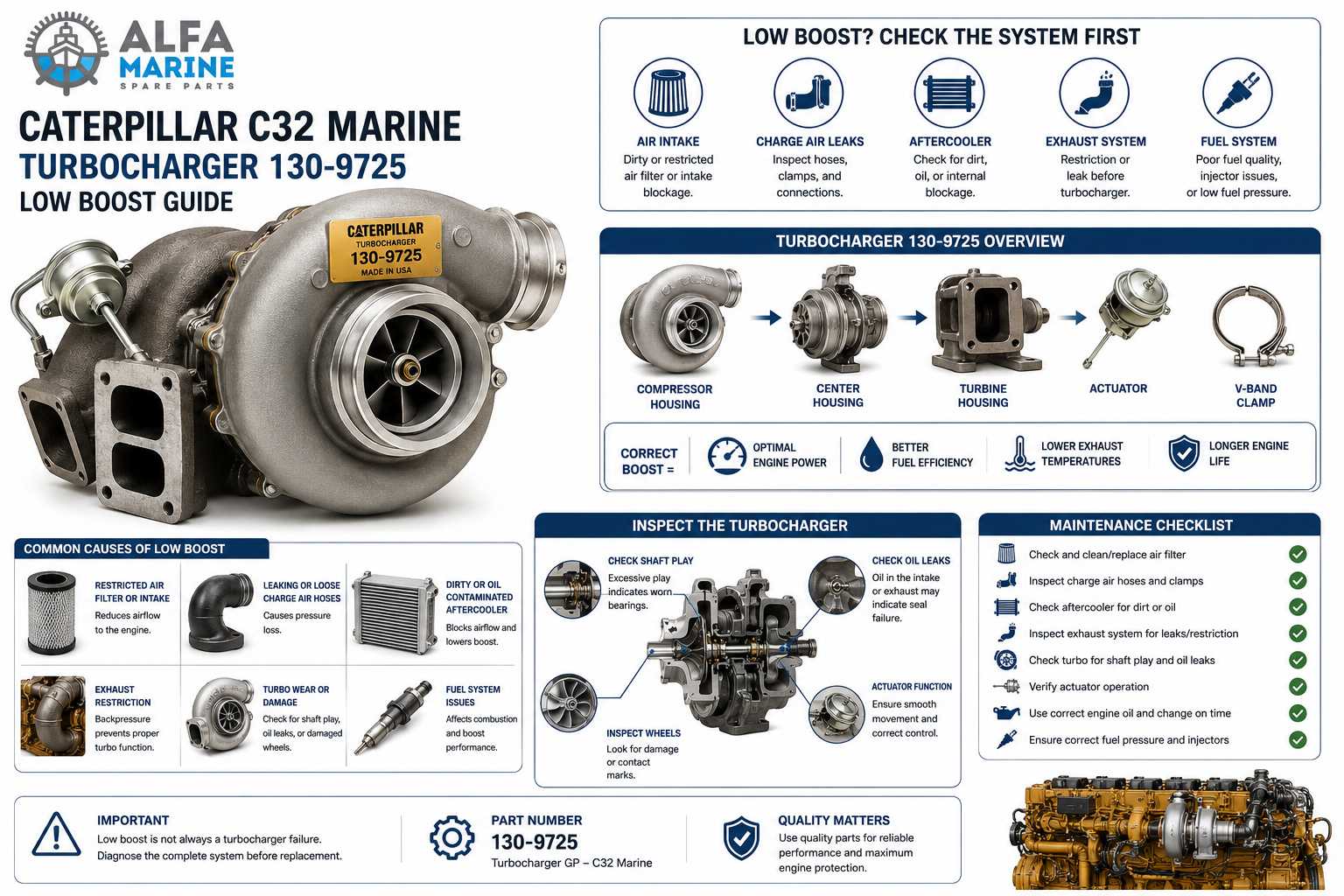
Caterpillar C32 Marine Turbocharger 130-9725 / 10R-8236 Guide
Low boost pressure on a Caterpillar C32 Marine engine does not automatically mean the turbocharger has failed.
The turbocharger works as part of the complete air-handling and exhaust system. Intake restriction, charge-air leakage, charge-air cooler condition, exhaust problems and engine operating conditions can all influence boost performance.
The turbocharger references covered in this guide are:
Engine: Caterpillar C32 Marine
Component: Turbocharger Group
Original Part Number: 130-9725 / 1309725
Cat Reman Reference: 10R-8236 / 10R8236
Caterpillar identifies 130-9725 / 1309725 as a turbocharger group for C30 and C32 marine applications and lists 10R-8236 / 10R8236 as its Cat Reman alternative.
These references should not be treated as universal for every Caterpillar C32 Marine engine.
Before ordering, verify:
Engine model + Engine Serial Number (ESN) + arrangement number + existing turbocharger part number
Caterpillar C32 Turbocharger Part Numbers
The part-number relationship covered in this guide is:
| Engine ApplicationOriginal TurbochargerCat Reman | ||
| C30 / C32 Marine | 130-9725 / 1309725 | 10R-8236 / 10R8236 |
Caterpillar currently lists 130-9725 as discontinued and identifies 10R-8236 as the Reman alternative.
The important relationship is:
130-9725 / 1309725 → 10R-8236 / 10R8236 Cat Reman
However, this does not mean every C32 uses this turbocharger.
Different C32 arrangements and ratings can require different components. Always verify the individual engine before ordering.
What Does the C32 Turbocharger Do?
The turbocharger uses energy from the engine's exhaust gases to drive a turbine connected to a compressor.
The compressor increases the amount of air supplied to the engine.
A simplified airflow path is:
Air intake → turbocharger compressor → charge-air cooler → intake manifold → cylinders
The exhaust side can be simplified as:
Cylinders → exhaust manifold → turbocharger turbine → exhaust system
Because these components operate together, a problem elsewhere in the system can create symptoms that resemble poor turbocharger performance.
Low Boost Doesn't Automatically Mean Turbocharger Failure
When a C32 develops lower-than-expected boost, immediately replacing the turbocharger can be an expensive diagnostic mistake.
Before condemning 130-9725 / 1309725 or replacing it with 10R-8236 / 10R8236, investigate possible causes including:
- Air-intake restriction
- Restricted air filters
- Intake-piping problems
- Charge-air leakage
- Loose or damaged connections
- Charge-air cooler restriction
- Charge-air cooler leakage
- Exhaust leakage
- Exhaust-system restriction
- Turbocharger deterioration
- Fuel or combustion problems
- Engine operating conditions
The turbocharger may ultimately be responsible.
But low boost alone does not prove turbocharger failure.
Diagnose the complete system before replacing the turbocharger.
Check Air-Intake Restriction First
The turbocharger compressor needs an adequate supply of clean air.
If the intake system becomes restricted, engine airflow and performance can be affected.
Inspect applicable areas such as:
- Air filters
- Intake piping
- Flexible connections
- Intake ducts
- Damaged or collapsed sections
- Foreign material
- Other obstructions
Where required, intake restriction should be measured according to the technical procedure applicable to the exact C32 configuration.
Do not rely only on visual inspection.
Check for Charge-Air Leakage
Compressed air leaving the turbocharger must reach the engine without excessive leakage.
A damaged hose, loose connection, failed seal or leaking cooler can allow compressed air to escape.
This creates an important diagnostic situation:
The turbocharger may still be producing compressed air, while the engine receives less air than expected.
Inspect for:
- Loose charge-air connections
- Damaged hoses
- Failed seals
- Cracked piping
- Oil staining around joints
- Cooler leakage
- Other evidence of pressure loss
Oil staining can identify an area that deserves closer inspection, but it does not automatically prove that the joint is leaking under boost.
Where appropriate, pressure testing can provide stronger evidence.
Inspect the Charge-Air Cooler
The charge-air cooler is another important part of C32 air-system diagnosis.
Possible problems include:
- Air-side restriction
- Internal contamination
- Leakage
- Cooling-side fouling
- Damaged connections
- Reduced heat-transfer performance
A charge-air cooler problem can affect airflow, intake-air temperature and overall engine performance.
If the C32 develops low boost or loss of power, cooler condition should therefore be considered before the turbocharger is condemned.
Check the Exhaust Side
The turbine side of the turbocharger depends on exhaust-gas energy.
Problems in the exhaust system can influence turbocharger performance.
Depending on the vessel installation, investigate:
- Exhaust leakage before the turbine
- Exhaust-manifold connections
- Gasket leakage
- Turbocharger mounting
- Exhaust restriction
- Excessive backpressure
- Damaged downstream components
Soot tracking around an exhaust connection can provide a useful visual clue that an area deserves closer inspection.
A significant exhaust leak before the turbine can reduce the energy available to drive the turbocharger.
Compare Boost at Similar RPM and Load
Boost pressure varies with engine operating conditions.
A boost reading recorded at light load should not be compared directly with one recorded during heavy propulsion load.
For meaningful comparison, use reasonably similar:
RPM + engine load + vessel operating conditions
Suppose a C32 historically produces consistent boost at a particular RPM and load.
Later, under comparable conditions, boost is consistently lower.
That change deserves investigation.
The useful diagnostic question is:
What changed?
A trend under comparable operating conditions is more useful than diagnosing the turbocharger from one isolated reading.
Low Boost and Black Smoke
Low boost combined with black exhaust smoke can provide a useful diagnostic clue.
Black smoke can occur when the amount of available air is insufficient relative to the fuel being burned.
If low boost and black smoke appear together, investigate the complete airflow path:
Air intake → turbocharger → charge-air piping → charge-air cooler → engine
Also consider the fuel and exhaust systems.
Do not automatically conclude:
Low boost + black smoke = failed turbocharger
A restricted intake or charge-air leak can potentially produce similar symptoms.
C32 Losing Power Under Load
A Caterpillar C32 may appear to operate normally at light load but lose performance as propulsion demand increases.
Higher engine output requires substantially more airflow.
A developing restriction or leak may therefore become much more noticeable under heavy load.
Possible symptoms can include:
- Reduced boost
- Loss of power
- Difficulty reaching expected RPM
- Black smoke
- Higher exhaust temperature
- Slow acceleration
- Changed turbocharger sound
These symptoms should be investigated together rather than using one symptom alone to select a replacement component.
Inspect Turbocharger 130-9725
Once the surrounding air and exhaust systems have been checked, inspect the turbocharger according to the applicable Caterpillar procedure.
Areas requiring attention may include:
- Compressor-wheel condition
- Turbine-wheel condition
- Shaft condition
- Housing condition
- Evidence of wheel contact
- Oil leakage
- Foreign-object damage
- Carbon deposits
- Oil supply
- Oil drain
Do not condemn the turbocharger simply because some shaft movement can be felt.
Turbocharger clearances are design-specific and should be evaluated against the correct specifications.
Turbocharger Lubrication Matters
Proper lubrication is critical to turbocharger life.
If a turbocharger has genuinely failed, investigate whether another problem contributed to the damage.
Consider:
Engine oil condition → turbocharger oil supply → bearings → turbocharger oil drain
Possible problems can include:
- Contaminated engine oil
- Restricted oil supply
- Inadequate lubrication
- Restricted oil drain
- Foreign material
- Abnormal operating conditions
Replacing a failed turbocharger without correcting the underlying cause can put the replacement unit at risk.
The important question is not only:
Which turbocharger failed?
It is also:
Why did it fail?
130-9725 and Cat Reman 10R-8236
Caterpillar currently identifies 10R-8236 / 10R8236 as the Cat Reman alternative for 130-9725 / 1309725.
The relationship is:
130-9725 / 1309725 → 10R-8236 / 10R8236
Caterpillar also lists the 10R-8236 Reman turbocharger for compatible marine applications including C15, C30 and C32 engines.
Exact compatibility must still be established against the individual engine.
A Reman relationship does not make the turbocharger universal across every C32 configuration.
Why 130-9725 Is Not Universal for Every C32
The Caterpillar C32 marine engine family exists in different arrangements, ratings and configurations.
Turbocharger selection can depend on:
- Engine Serial Number
- Arrangement number
- Engine rating
- Rated RPM
- Marine application
- Air-system configuration
- Production configuration
- Existing turbocharger
This is why:
C32 Marine does not automatically equal 130-9725.
Likewise:
10R-8236 should not be treated as the correct Reman turbocharger for every C32.
Always verify the exact engine before ordering.
Don't Replace the Turbocharger Based on Boost Pressure Alone
A practical diagnostic sequence is:
1. Confirm the Low-Boost Condition
Compare current readings with the appropriate specifications or established operating trends.
2. Confirm RPM and Load
Make sure the comparison is being made under meaningful operating conditions.
3. Check Intake Restriction
Inspect the air filters and intake path.
4. Check the Charge-Air System
Look for leaks, loose connections and damaged piping.
5. Inspect the Charge-Air Cooler
Consider leakage, restriction and cooling performance.
6. Inspect the Exhaust System
Check for upstream exhaust leakage and downstream restriction.
7. Inspect the Turbocharger
Evaluate the turbo according to the applicable Caterpillar procedure.
8. Consider Engine Condition
Fuel delivery, combustion and other engine problems can influence boost and exhaust behavior.
This approach helps avoid replacing an expensive turbocharger when the actual problem exists elsewhere.
Ordering Caterpillar C32 Turbocharger 130-9725 / 10R-8236
The components covered in this guide are:
Engine: Caterpillar C32 Marine
Component: Turbocharger Group
Original: 130-9725 / 1309725
Cat Reman: 10R-8236 / 10R8236
When requesting a replacement, provide:
Engine model + complete Engine Serial Number + arrangement number + existing turbocharger part number
It can also help to provide:
- Engine data-plate photograph
- Turbocharger identification photograph
- Existing Reman number, if applicable
- Vessel application
- Required quantity
For Caterpillar C32 engine components, visit Caterpillar C32 Marine Engine Parts.
Email: request@alfamarinespareparts.com
Request a Quote
Frequently Asked Questions
What is Caterpillar part number 130-9725?
130-9725 / 1309725 is a Caterpillar turbocharger group associated with C30 and C32 marine-engine applications. Caterpillar currently lists the original part as discontinued.
What is the Cat Reman reference for 130-9725?
The Cat Reman alternative identified by Caterpillar is 10R-8236 / 10R8236.
Does 130-9725 fit every Caterpillar C32?
No. Caterpillar C32 engines exist in different arrangements and configurations. Verify the engine serial number and arrangement before ordering.
Does low boost mean the C32 turbocharger has failed?
Not necessarily. Intake restriction, charge-air leakage, charge-air cooler problems, exhaust issues and other engine conditions can also affect boost.
Can a charge-air leak cause low boost?
Yes. Compressed air can escape before reaching the engine, reducing effective charge-air delivery.
Can a restricted air filter affect boost and engine power?
Yes. Air-intake restriction can reduce available airflow and affect engine performance.
Can exhaust leakage affect turbocharger performance?
Yes. Significant exhaust leakage before the turbine can reduce the exhaust energy available to drive the turbocharger.
Is 10R-8236 a Cat Reman turbocharger?
Yes. Caterpillar identifies 10R-8236 / 10R8236 as a Cat Reman turbocharger.
What information should I provide when ordering a C32 turbocharger?
Provide the complete engine serial number, arrangement number and existing turbocharger part number, preferably with identification photographs.
Conclusion
Low boost on a Caterpillar C32 Marine engine does not automatically mean turbocharger 130-9725 / 1309725 has failed.
Before removing the turbocharger, investigate the complete air-handling system:
Air intake → turbocharger → charge-air piping → charge-air cooler → engine → exhaust manifold → turbine → exhaust system
The important part-number relationship is:
130-9725 / 1309725 → 10R-8236 / 10R8236 Cat Reman
However, neither reference should be assumed to fit every C32 configuration.
Always verify:
Engine Serial Number + arrangement number + existing turbocharger part number
A useful engine-room principle is:
Check the intake and charge-air system before condemning the turbocharger.
For C32 turbochargers and other parts, visit Caterpillar C32 Marine Engine Parts.
Email: request@alfamarinespareparts.com