Correct. For the publishable version, no third-party links. I’ll keep only Alfa Marine Spare Parts internal links.
MTU 12V 2000 M72 Seawater Pump X51220700001 Guide
The seawater pump is an important part of the cooling system on an MTU 12V 2000 M72 marine engine.
After replacing a seawater pump, the job is not finished simply because the new pump has been installed. The complete seawater circuit should be checked before placing the engine under significant load.
The pump reference covered in this guide is:
Engine: MTU 12V 2000 M72
Component: Seawater / Raw-Water Pump
Part Number: X51220700001
Part number X51220700001 is documented as a seawater-pump reference associated with certain MTU 12V 2000 M72 applications.
However, it should not be treated as universal for every 12V 2000 M72 installation.
Before ordering, verify:
Complete engine model + engine serial number + existing pump identification
MTU 12V 2000 M72 Seawater Pump
The pump reference covered in this guide is:
| EngineComponentPart Number | ||
| MTU 12V 2000 M72 | Seawater / Raw-Water Pump | X51220700001 |
Correct identification is important because MTU Series 2000 engines exist in different generations, ratings and configurations.
A pump should not be selected simply because it is advertised for an MTU Series 2000 engine.
The individual engine must be identified first.
What Does the Seawater Pump Do?
The seawater pump moves raw seawater through the marine side of the cooling system.
A simplified seawater path can be represented as:
Sea intake → seacock → sea strainer → seawater pump → cooling components → discharge
The exact routing depends on the vessel and engine installation.
The seawater circuit removes heat from the engine's cooling systems. Reduced seawater flow can therefore lead to increasing operating temperatures, particularly as engine load rises.
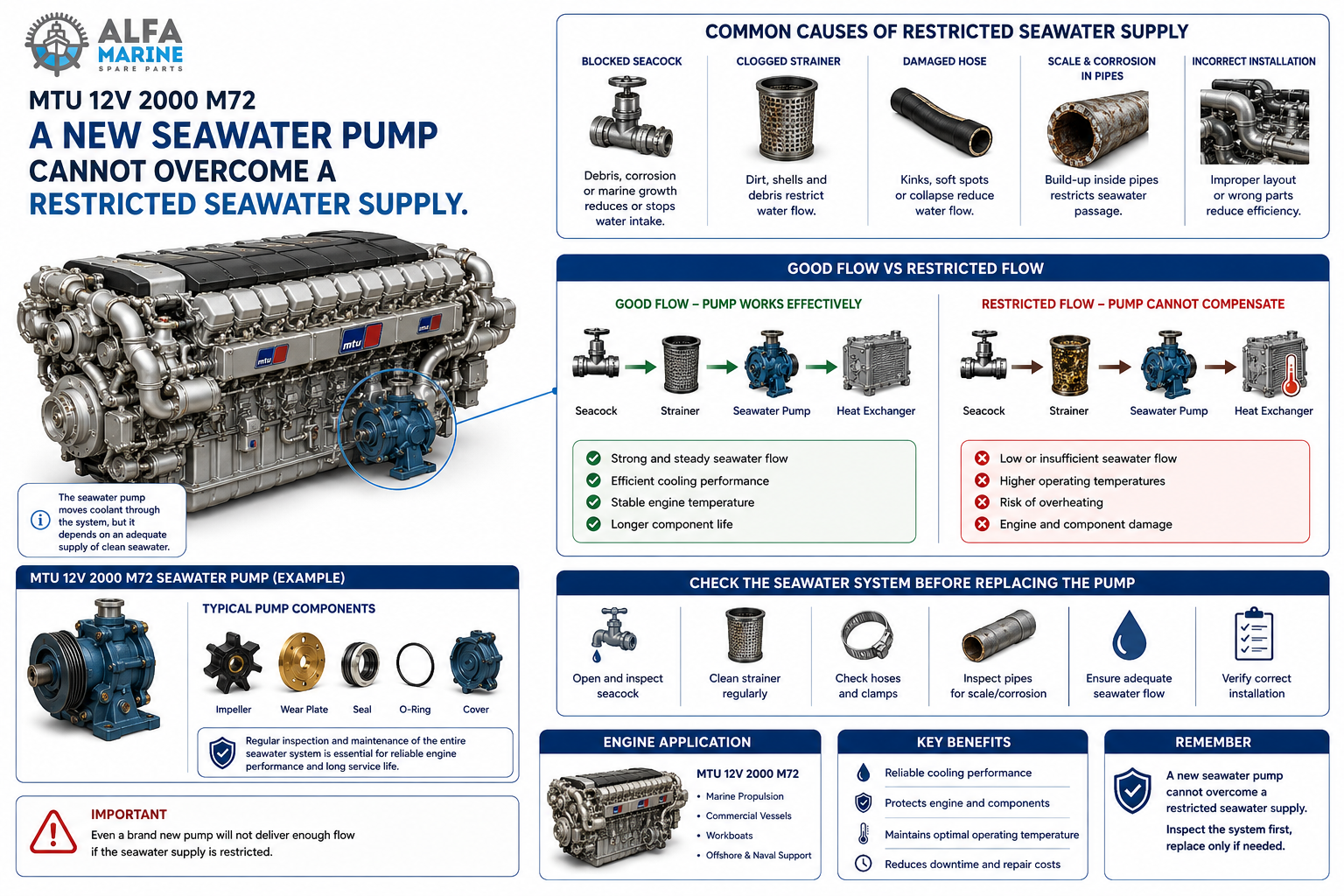
A New Seawater Pump Cannot Overcome a Blocked Strainer
This is one of the most important checks after replacing X51220700001.
Installing a new seawater pump does not correct a restriction elsewhere in the cooling circuit.
Inspect applicable components including:
- Sea intake
- Seacock
- Sea strainer
- Suction hoses
- Hose connections
- Collapsed or damaged hoses
- Marine growth
- Foreign material
- Other restrictions
A restricted strainer can reduce the amount of seawater available to the pump.
A new pump still requires an unrestricted water supply.
Check the Seacock and Suction Valves
Before operating the engine after seawater-system maintenance, confirm that all applicable seawater valves are correctly positioned.
Valves may have been closed intentionally during maintenance.
A closed or partially closed valve can restrict the pump's water supply.
Follow the seawater path from the hull intake toward the pump and confirm that the system has been correctly returned to operating condition.
Check Priming Before Loading the Engine
After installation, make sure the seawater system is restored correctly before placing the engine under significant load.
Check applicable areas including:
- Seacock position
- Strainer condition
- Suction-hose connections
- Hose condition
- Possible suction-side air entry
- Pump installation
- Seawater circulation
Do not assume that installation of a new pump automatically means the system is ready for full-load operation.
Check Seawater Flow After Installation
Once X51220700001 has been installed and the seawater circuit returned to service, verify cooling-system operation.
Depending on the vessel installation, check for:
- Expected seawater circulation
- Abnormal leakage
- Abnormal pump noise
- Hose problems
- Connection leakage
- Cooling-water discharge behavior
- Stable engine temperatures
The objective is to confirm that the complete cooling system is operating correctly, not simply that the new pump is turning.
Normal at Idle but Hotter Under Load?
An MTU 12V 2000 M72 can appear to operate normally at idle even when seawater flow is partially restricted.
At low load, the engine produces considerably less heat.
As propulsion load increases, cooling demand also increases.
A restriction that causes little noticeable effect at idle may become much more significant under sustained load.
A useful diagnostic pattern is:
Normal temperature at idle → gradual temperature increase under load
If this occurs, investigate the complete cooling system rather than automatically blaming the seawater pump.
Follow the Complete Seawater Path
When seawater flow appears lower than expected, work through the system logically:
Sea intake → seacock → strainer → suction hose → seawater pump → cooling components → discharge
Possible problems can include:
- Blocked sea intake
- Fouled strainer
- Restricted suction hose
- Suction-side air entry
- Pump deterioration
- Heat-exchanger restriction
- Cooler fouling
- Restricted discharge
The seawater pump is important, but it is only one part of the cooling circuit.
Check for Suction-Side Air Leaks
A seawater pump depends on the integrity of its suction side.
Air entering through a poor connection can interfere with the pump's ability to move water effectively.
Inspect applicable:
- Suction hoses
- Clamps
- Strainer seals
- Connections
- Gaskets
- Fittings
A suction-side air leak may not necessarily produce an obvious external water leak.
This makes connection condition particularly important when cooling performance changes after maintenance.
Inspect the Removed Pump
The old pump can provide useful diagnostic evidence.
Before discarding it, inspect for:
- Internal wear
- Impeller deterioration
- Seal leakage
- Shaft condition
- Bearing condition
- Corrosion
- Drive damage
- Evidence of abnormal contact
If unusual damage is present, investigate why it occurred.
Replacing the pump without understanding the original failure can leave the underlying problem unresolved.
Monitor Temperature After Pump Replacement
After installing the pump and confirming initial seawater circulation, continue monitoring engine temperatures during subsequent operation.
Do not rely only on the absence of an alarm.
Where possible, compare temperatures under similar:
RPM + engine load + seawater conditions
A gradual change from the engine's established operating trend can provide an early indication that cooling-system performance deserves investigation.
Twin-Engine Installations Can Provide a Useful Comparison
On vessels with comparable twin-engine installations, the other engine can provide useful reference data.
Under reasonably similar operating conditions, compare:
- Coolant temperature
- Charge-air temperature
- Oil temperature
- RPM
- Engine load
- Seawater-system behavior
A consistent difference between engines can help identify where further investigation is required.
However, make sure the engines, ratings and operating loads are genuinely comparable before drawing conclusions.
Why X51220700001 Should Still Be Verified
Although X51220700001 is documented as a seawater-pump reference associated with certain MTU 12V 2000 M72 applications, it should not automatically be assumed correct for every engine.
Pump selection can depend on:
- Complete engine designation
- Engine serial number
- Engine build
- Marine configuration
- Existing pump
- Cooling-system arrangement
- Previous modifications
This is particularly important with engines that have been in service for many years.
Engine model alone is not always enough for reliable parts identification.
Ordering MTU X51220700001 Seawater Pump
The component covered in this guide is:
Engine: MTU 12V 2000 M72
Component: Seawater / Raw-Water Pump
Part Number: X51220700001
When requesting the pump, provide:
Complete engine model + engine serial number + existing seawater-pump part number
Clear photographs can also help with identification, particularly:
- Engine data plate
- Existing pump
- Pump identification
- Drive side
- Hose connections
For MTU Series 2000 seawater pumps and related marine-engine components, contact Alfa Marine Spare Parts.
Email: request@alfamarinespareparts.com
Request a Quote
Frequently Asked Questions
What is MTU part number X51220700001?
X51220700001 is a seawater-pump reference associated with certain MTU 12V 2000 M72 applications.
Is X51220700001 a seawater pump or coolant pump?
The reference covered in this guide is for a seawater / raw-water pump, which should not be confused with the engine's closed-circuit coolant pump.
Does X51220700001 fit every MTU 12V 2000?
No. Different Series 2000 models and configurations can use different pump arrangements. Always verify the engine serial number and existing pump.
Can a blocked sea strainer cause poor cooling with a new pump?
Yes. A new seawater pump cannot compensate for a significantly restricted seawater intake or blocked strainer.
Why should seawater valves be checked after replacing the pump?
Valves may have been closed during maintenance. Correct valve position should be confirmed before returning the cooling system to normal operation.
Should the engine be placed under full load immediately after changing the pump?
Cooling-system operation and seawater circulation should first be confirmed according to the applicable MTU and vessel procedures.
Can the engine run normally at idle but become hotter under load?
Yes. A partially restricted cooling system may provide sufficient cooling at low load but become inadequate as engine heat rejection increases.
What information should I provide when ordering X51220700001?
Provide the complete engine designation, engine serial number and existing pump identification, preferably with clear photographs.
Conclusion
When replacing seawater pump X51220700001 on an MTU 12V 2000 M72, do not treat installation of the new pump as the end of the job.
Confirm the complete seawater circuit:
Sea intake → seacock → strainer → suction hoses → seawater pump → cooling components → discharge
Check that the applicable valves are correctly positioned, the suction side is unrestricted and seawater circulation has been restored before placing the engine under significant load.
Most importantly:
A new seawater pump cannot overcome a blocked strainer or restricted seawater supply.
Before ordering X51220700001, verify:
Engine model + engine serial number + existing pump identification MTU Series 2000 Marine Engine Spare Parts | Alfa Marine Spare Parts
For MTU Series 2000 parts and seawater pumps, contact Alfa Marine Spare Parts.
Email: request@alfamarinespareparts.com