
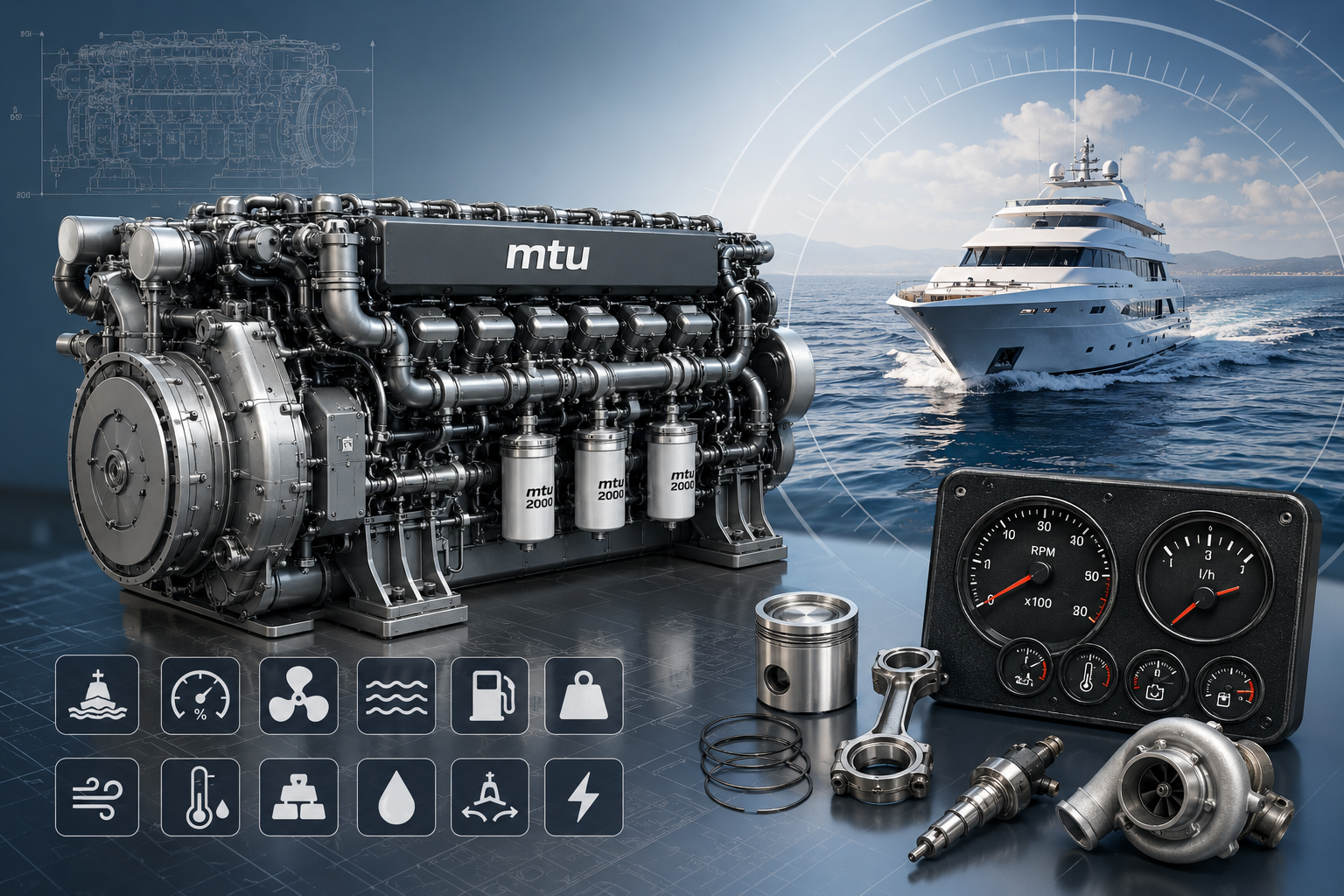
What Is the Fuel Consumption of an MTU 16V 2000 at Cruising Speed?
The fuel consumption of an MTU 16V 2000 cannot be accurately determined from yacht cruising speed alone.
This matters when captains, yacht managers and marine engineers are planning fuel requirements. The engine produces propulsion power, but the vessel's hull, displacement, propulsion system and operating conditions determine how much power is required to maintain a particular speed.
Two yachts fitted with the same MTU 16V 2000 engines can therefore both travel at 20 knots while consuming significantly different amounts of fuel.
For meaningful fuel planning, consider:
Exact engine model + RPM + engine load + vessel configuration + actual operating conditions
For the complete engine family, visit MTU Series 2000 Marine Engine Parts.
There Is No Universal MTU 16V 2000 Fuel Consumption at 20 Knots
A generic chart claiming that every MTU 16V 2000 consumes a particular number of litres per hour at 10, 15, 20 or 25 knots would be misleading.
Fuel consumption at a particular vessel speed depends on factors including:
- Exact MTU engine model and rating
- Actual engine load
- Hull design
- Vessel displacement
- Propeller or waterjet configuration
- Gear ratio
- Vessel loading
- Fuel and water carried
- Hull condition
- Propeller condition
- Trim
- Stabilizer drag
- Sea state
- Wind
- Current
The important distinction is:
Engine fuel consumption is primarily related to engine output and operating condition. Vessel fuel consumption at a particular speed depends on how much propulsion power the vessel requires to maintain that speed.
This is why a generic search result for “MTU 16V 2000 fuel consumption at 20 knots” should not be used by itself for passage planning.
Which MTU 16V 2000 Engine Do You Have?
MTU 16V 2000 does not identify one single engine specification.
The Series 2000 family has been produced in different generations, ratings and marine applications.
Important V16 marine versions include:
- MTU 16V 2000 M72
- MTU 16V 2000 M86
- MTU 16V 2000 M91
- MTU 16V 2000 M93
- MTU 16V 2000 M94
- MTU 16V 2000 M96
- MTU 16V 2000 M96L
- MTU 16V 2000 M97
- MTU 16V 2000 M97L
These engines should not be assumed to have identical power ratings, duty profiles, fuel-consumption characteristics or component specifications.
Before calculating fuel requirements or ordering engine parts, identify the complete engine designation and use technical information applicable to that exact engine and rating.
For the wider family, visit MTU Series 2000 Marine Engine Parts.
MTU 16V 2000 M96 Fuel Consumption
The MTU 16V 2000 M96 provides a useful example of why rated fuel consumption and yacht cruising consumption should be kept separate.
| SpecificationMTU 16V 2000 M96 | |
| Configuration | V16 |
| Displacement | 35.7 litres |
| Rated power | 1,790 kW / 2,400 bhp |
| Rated speed | 2,450 rpm |
| Specific fuel consumption at rated power | Approx. 215 g/kWh |
| Approx. fuel consumption at rated power | 464 L/h |
The important wording here is:
At Rated Power
Approximately 464 litres per hour should not be described as normal cruising consumption for every yacht fitted with an M96.
For a twin-engine installation:
464 × 2 = approximately 928 L/h
But approximately 928 L/h simply represents the mathematical total for two engines operating at that stated rated operating point.
It is not a universal twin-engine cruising figure.
MTU 16V 2000 M96L Fuel Consumption
The MTU 16V 2000 M96L is a higher-output Series 2000 variant.
| SpecificationMTU 16V 2000 M96L | |
| Configuration | V16 |
| Displacement | 35.7 litres |
| Rated power | 1,939 kW / 2,600 bhp |
| Rated speed | 2,450 rpm |
| Specific fuel consumption at rated power | Approx. 216 g/kWh |
| Approx. fuel consumption at rated power | 505 L/h |
For a twin-engine installation:
505 × 2 = approximately 1,010 L/h
Again, approximately 1,010 L/h should not be described as normal yacht cruising consumption.
It represents two engines operating at the stated rated operating point.
MTU 16V 2000 M96 vs M96L Fuel Consumption
| EngineRated PowerRated SpeedApprox. Rated-Point Fuel Consumption | |||
| 16V 2000 M96 | 1,790 kW / 2,400 bhp | 2,450 rpm | 464 L/h |
| 16V 2000 M96L | 1,939 kW / 2,600 bhp | 2,450 rpm | 505 L/h |
These are useful engine reference values.
They should not automatically be interpreted as:
- 15-knot consumption
- 20-knot consumption
- 25-knot consumption
- Normal yacht cruising consumption
Actual cruising consumption must be established for the individual vessel and operating condition.
What Is MTU 16V 2000 Fuel Consumption at Cruising Speed?
The technically accurate answer is:
It depends on how much engine power the vessel requires at its chosen cruising speed.
Imagine two yachts fitted with twin MTU 16V 2000 M96L engines.
One yacht is relatively light, with a clean hull, efficient propulsion system and moderate loading.
The other is heavier, carries more fuel and water, has different propulsion characteristics or greater underwater resistance.
Both vessels may travel at 20 knots.
However, their engines may operate at different loads.
Their litres-per-hour consumption can therefore be different even though:
Engine model = same
and:
Vessel speed = same
This is why vessel speed alone is insufficient for calculating MTU fuel consumption.
Why Is Engine Load More Important Than Yacht Speed?
Engine load tells you much more about what the engine is actually being asked to produce.
Two yachts can both travel at 18 knots while requiring very different amounts of propulsion power.
One vessel may operate its engines relatively lightly.
Another may require significantly more output because of:
- Greater displacement
- Hull fouling
- Propeller condition
- Different propulsion system
- Different gear ratio
- Hull design
- Sea conditions
For understanding engine fuel consumption, the more useful relationship is:
Fuel consumption ↔ engine output/load
rather than simply:
Fuel consumption ↔ vessel speed
Is RPM Enough to Calculate MTU Fuel Consumption?
No.
RPM is important, but RPM and engine load are not the same thing.
An engine operating at a particular RPM can experience different loads depending on vessel resistance and propeller demand.
Changes in:
- Hull fouling
- Propeller condition
- Vessel displacement
- Trim
- Sea state
can change the power required from the engine even when RPM remains similar.
For meaningful fuel analysis, compare:
RPM + engine load + fuel rate + vessel speed
rather than RPM alone.
Build Your Own MTU 16V 2000 Fuel-Consumption Curve
A much more useful approach is to build a vessel-specific fuel curve.
Record several stable operating points under reasonably comparable conditions.
| Vessel SpeedRPMPort LoadStarboard LoadPort L/hStarboard L/hTotal L/h | ||||||
| 10 kn | — | — | — | — | — | — |
| 12 kn | — | — | — | — | — | — |
| 15 kn | — | — | — | — | — | — |
| 18 kn | — | — | — | — | — | — |
| 20 kn | — | — | — | — | — | — |
| Normal cruise | — | — | — | — | — | — |
This becomes the yacht's own fuel-consumption curve.
For passage planning, this is much more useful than applying a generic online litres-per-hour figure to every MTU-powered yacht.
Why Can MTU Fuel Consumption Increase Over Time?
Suppose your yacht historically maintained its normal cruising speed at a particular load and fuel rate.
Later, under reasonably comparable conditions:
Fuel consumption increases while vessel speed decreases.
It would be premature to immediately blame the injectors or turbochargers.
Possible causes include:
- Hull fouling
- Propeller fouling
- Propeller damage
- Increased vessel displacement
- Different trim
- Changed sea conditions
- Propulsion-system losses
- Engine-performance deterioration
The vessel's own historical operating data are therefore extremely useful.
Instead of asking:
“Does another yacht with MTU 16V 2000 engines use the same amount of fuel?”
ask:
“Is my vessel now requiring more power or fuel than it previously required under comparable conditions?”
Can Hull and Propeller Condition Increase Fuel Consumption?
Yes.
Marine growth increases hydrodynamic resistance.
A damaged, fouled or inefficient propeller can also reduce propulsion efficiency.
If additional engine power is required to maintain the same vessel speed, fuel consumption can increase.
A useful trend is:
Same vessel speed + comparable conditions + higher engine load/fuel rate
That deserves investigation.
It does not automatically prove there is an internal engine problem.
Can MTU Engine Condition Increase Fuel Consumption?
Yes.
Once vessel and environmental factors have been considered, engine condition should also be evaluated.
Depending on the symptoms, engineers may investigate:
- Fuel injection
- Fuel supply
- Fuel pressure
- Turbocharger operation
- Air intake
- Charge-air cooling
- Exhaust system
- Engine sensors
- Engine-management data
Fuel-injection problems can potentially be associated with:
- Poor combustion
- Increased smoke
- Uneven exhaust temperatures
- Reduced performance
- Increased fuel consumption
Turbocharger or charge-air problems can affect the amount of air available for combustion and reduce engine performance.
For more information about the air system, see MTU 2000 Turbocharger Inspection & Repair.
MTU 16V 2000 Parts Related to Increased Fuel Consumption
If an MTU 16V 2000 begins consuming more fuel than its historical operating trend under comparable conditions, several engine systems may deserve investigation.
Fuel System
Relevant components can include:
- Fuel injectors
- High-pressure fuel-system components
- Fuel supply components
- Fuel filters
- Fuel-pressure sensors
An injector should not be replaced solely because fuel consumption has increased.
Look for supporting evidence such as:
- Abnormal smoke
- Uneven combustion
- Cylinder-to-cylinder exhaust-temperature differences
- Poor acceleration
- Reduced power
- Fuel-system faults or alarms
Turbocharger and Charge-Air System
Relevant components can include:
- Turbochargers
- Turbocharger repair components
- Charge-air coolers
- Intake-air components
- Pressure sensors
- Temperature sensors
A turbocharger problem becomes more convincing when increased fuel consumption is accompanied by symptoms such as reduced boost, smoke, high exhaust temperature or poor engine response.
See MTU 2000 Turbocharger Inspection & Repair.
Cooling System
Relevant components can include:
- Seawater pumps
- Freshwater pumps
- Heat exchangers
- Charge-air coolers
- Cooling-system sensors
- Related hoses and seals
Cooling-system condition should be evaluated as part of the complete engine operating picture rather than assuming that a seawater pump is responsible for increased fuel consumption.
See the MTU Series 2000 Seawater Pump Guide.
Engine Monitoring and Controls
Relevant components and systems can include:
- Pressure sensors
- Temperature sensors
- Speed sensors
- Wiring and connectors
- Engine-control components
A suspicious sensor value should be verified before replacing the sensor.
Why Specific M96 and M96L Part Numbers Are Not Listed Here
This is intentional.
An MTU 16V 2000 M96 or M96L contains many service components, but the engine-family name alone is not sufficient to assign every injector, turbocharger, pump, sensor or electronic component.
The Series 2000 covers multiple generations and configurations.
For example, a component used on the MTU 16V 2000 M72, MTU 16V 2000 M86 or MTU 16V 2000 M91 should not automatically be described as suitable for an M96 or M96L.
For critical replacement components, use:
Complete engine model + engine serial number + existing component part number
This is particularly important for:
- Injectors
- High-pressure fuel components
- Turbochargers
- Seawater pumps
- Sensors
- Electronic control components
For engine and component enquiries, visit MTU Series 2000 Marine Engine Parts.
Important: Keep MTU Part Numbers in Their Original Format
MTU part numbers should be published in the format actually used for the component.
Do not add arbitrary hyphens simply to create an additional SEO variation.
For example, if an MTU part number is officially written as:
X53507500012
it should remain:
X53507500012
Do not convert it into an invented format such as:
X535-0750-0012
The same principle applies to numeric MTU references.
Part-number accuracy is more important than creating artificial search variations.
Can Cooling-System Condition Affect Engine Performance?
Yes.
Cooling-system condition forms part of the overall operating picture.
Changes in seawater flow, charge-air cooling or engine temperatures can accompany performance changes under load.
Potential areas include:
- Sea strainer
- Seawater pump
- Hoses
- Piping
- Heat exchanger
- Charge-air cooling
- Oil cooler
- Restrictions
The complete cooling circuit should be evaluated rather than immediately assuming the seawater pump has failed.
For cooling-system information, see the MTU Series 2000 Seawater Pump Guide.
Compare Port and Starboard Engines
Twin-engine installations provide a useful diagnostic comparison.
If both engines are operating under comparable conditions but one engine consistently shows higher fuel consumption, investigate the difference.
Compare:
Engine load + RPM + fuel rate + charge-air data + coolant temperature + exhaust temperatures
For example:
Port engine: 1,800 rpm, 55% load, 150 L/h
Starboard engine: 1,800 rpm, 55% load, 180 L/h
Those figures are only an example. They are not MTU specifications.
A persistent difference under comparable operating conditions deserves investigation.
How Do You Calculate Litres per Nautical Mile?
Once actual vessel fuel-consumption data are available:
Litres per nautical mile = Total fuel consumption in L/h ÷ vessel speed in knots
For example:
400 L/h at 16 knots
gives:
400 ÷ 16 = 25 L/nm
This is purely a mathematical example.
400 L/h is not an MTU 16V 2000 specification.
Litres per nautical mile can be more useful than litres per hour when comparing the efficiency of different cruising speeds.
How Do You Calculate Fuel Required for a Passage?
Once the yacht's verified fuel consumption at the intended cruise condition is known:
Passage time = Distance ÷ Speed
For example:
Distance: 300 nautical miles
Speed: 15 knots
Estimated passage time:
300 ÷ 15 = 20 hours
If the vessel's own verified propulsion consumption at that operating point is 350 L/h:
20 × 350 = 7,000 litres
Again:
350 L/h is a calculation example. It is not an MTU specification.
Appropriate fuel reserves and other fuel-consuming equipment must be considered separately according to vessel requirements.
Don't Forget Generator and Auxiliary Fuel Consumption
Main-engine fuel consumption is only part of a yacht's total fuel requirement.
Additional fuel can be consumed by:
- Generators
- Heating equipment
- Auxiliary machinery
- Tender operations
- Extended hotel loads
For longer passages, auxiliary consumption can become significant.
Therefore:
Total voyage fuel requirement ≠ propulsion-engine fuel consumption alone
What Is the Most Economical Cruising Speed?
There is no universal economical cruising speed for every yacht equipped with MTU 16V 2000 engines.
Instead, use actual vessel data to calculate litres per nautical mile at several operating points.
| SpeedVerified Total L/hCalculated L/nm | ||
| 10 kn | Vessel data | Calculate |
| 12 kn | Vessel data | Calculate |
| 15 kn | Vessel data | Calculate |
| 18 kn | Vessel data | Calculate |
| 20 kn | Vessel data | Calculate |
This creates a vessel-specific efficiency curve.
An operating point with lower fuel consumption per nautical mile generally indicates better fuel efficiency, but economy is not the only consideration.
Engine loading, sea conditions, voyage schedule and vessel operating requirements also matter.
Engineer Tip: Trend Fuel Consumption Over Time
Fuel consumption can become a useful condition-monitoring parameter when operating data are recorded consistently.
Track:
RPM + engine load + fuel consumption + vessel speed + coolant temperature + charge-air parameters + exhaust temperatures + vessel loading
If the vessel gradually requires more engine load or more fuel to maintain the same speed under reasonably comparable conditions, something has changed.
The cause may involve:
Vessel resistance → propulsion efficiency → engine performance
Trend data provide a much stronger reason to begin diagnosis than replacing components simply because a generic fuel-consumption number appears high.
MTU 16V 2000 Engine Pages
For engine-specific information, browse the available Alfa Marine Spare Parts Series 2000 pages:
MTU 16V 2000 M72
MTU 16V 2000 M86
MTU 16V 2000 M91
MTU Series 2000 Marine Engine Parts
When selecting components, use the complete engine model and serial number rather than assuming that components are interchangeable across the Series 2000 family.
Frequently Asked Questions
How much fuel does an MTU 16V 2000 use per hour?
There is no single figure for every MTU 16V 2000 because the family contains different models and ratings.
For the engines discussed here, approximately 464 L/h for the M96 and 505 L/h for the M96L are rated-point reference figures, not universal cruising figures.
How much fuel does an MTU 16V 2000 M96 use?
Approximately 464 L/h at the stated rated operating point is a useful reference.
It should not be presented as normal cruising consumption.
How much fuel does an MTU 16V 2000 M96L use?
Approximately 505 L/h at the stated rated operating point is the relevant reference.
Actual cruising consumption depends on the power required by the individual vessel.
How much do twin MTU 16V 2000 M96 engines consume at rated power?
Using the stated rated-point reference:
464 × 2 = approximately 928 L/h
This does not represent universal cruising consumption.
How much do twin MTU 16V 2000 M96L engines consume at rated power?
Using the stated rated-point reference:
505 × 2 = approximately 1,010 L/h
Again, this is not a universal cruising figure.
How much fuel does an MTU 16V 2000 consume at 20 knots?
There is no universal accurate figure.
Consumption depends on the exact engine model and the propulsion power the individual vessel requires to maintain 20 knots.
Can RPM alone determine fuel consumption?
No.
RPM should be considered together with engine load and actual fuel-rate data.
Can a dirty hull increase fuel consumption?
Yes.
Increased hull resistance can require more propulsion power to maintain the same vessel speed.
Can propeller condition affect fuel consumption?
Yes.
Fouling or damage can reduce propulsion efficiency and change the relationship between RPM, engine load, fuel consumption and vessel speed.
Can injector problems increase fuel consumption?
Potentially.
Poor fuel delivery or combustion can affect smoke, exhaust temperatures, engine performance and fuel economy. Diagnose the fuel system before replacing injectors.
Can turbocharger problems increase fuel consumption?
A turbocharger or charge-air problem can reduce the air available for combustion and affect engine performance.
Look for supporting evidence such as abnormal boost, smoke, exhaust temperatures or reduced power.
Are parts interchangeable between M72, M86, M91, M93, M94, M96 and M96L?
Do not assume so.
Different Series 2000 generations and ratings can use different components and configurations.
Always verify the complete engine model, serial number and existing component number.
What information do I need when ordering MTU 16V 2000 parts?
Provide:
Complete engine model + engine serial number + existing component part number + quantity
Do not order critical components using “MTU 16V 2000” alone.
Conclusion: Use Engine Data for the Engine and Vessel Data for the Yacht
There is no technically accurate universal answer to:
“How much fuel does an MTU 16V 2000 consume at cruising speed?”
Useful rated-point references for the two engines discussed here are:
| EngineRated PowerRated SpeedApprox. Rated-Point Consumption | |||
| MTU 16V 2000 M96 | 1,790 kW / 2,400 bhp | 2,450 rpm | 464 L/h |
| MTU 16V 2000 M96L | 1,939 kW / 2,600 bhp | 2,450 rpm | 505 L/h |
Neither figure should be treated as normal yacht cruising consumption.
For accurate fuel planning:
Identify exact engine → establish actual operating load → record vessel fuel rate → calculate L/nm → build a vessel-specific fuel curve
This gives captains and engineers a much stronger basis for fuel planning than applying a generic litres-per-hour figure to a yacht simply because it uses MTU 16V 2000 engines.
MTU 16V 2000 & Series 2000 Parts
Alfa Marine Spare Parts can assist with enquiries for MTU Series 2000 components including:
- Fuel-system components
- Injectors
- Turbocharger components
- Seawater pumps
- Freshwater pumps
- Cooling-system components
- Pistons
- Cylinder liners
- Cylinder heads
- Bearings
- Gaskets
- O-rings
- Seals
- Sensors
- Overhaul components
Browse:
MTU Series 2000 Marine Engine Parts
MTU 16V 2000 M72
MTU 16V 2000 M86
MTU 16V 2000 M91
MTU 2000 Turbocharger Inspection & Repair
MTU Series 2000 Seawater Pump Guide
For accurate parts identification provide:
Complete engine model + engine serial number + existing part number + quantity
Email: request@alfamarinespareparts.com