
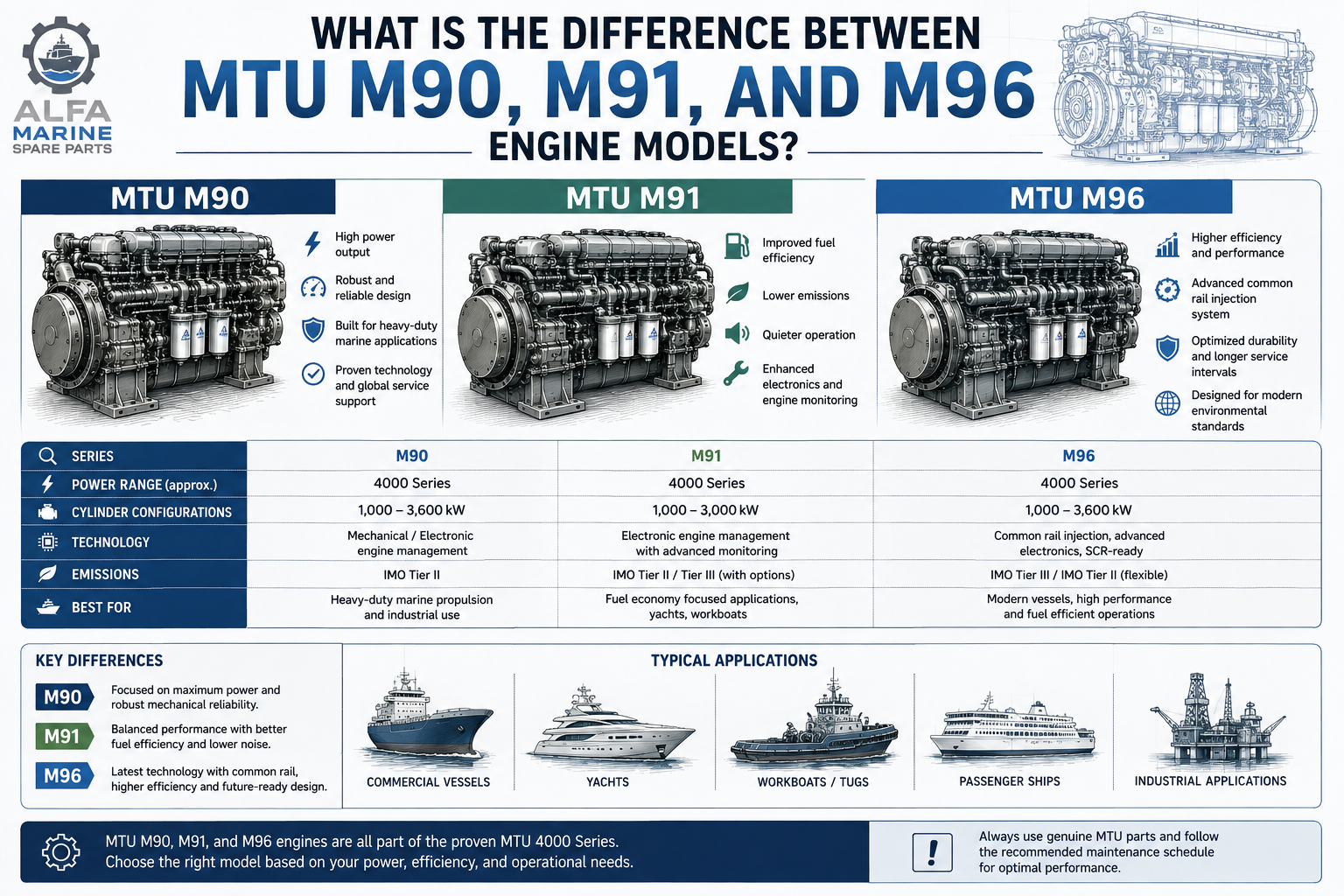
What Is the Difference Between MTU M90, M91L and M96 Engines?
MTU marine engine designations can be confusing because model suffixes such as M90, M91L and M96 may look like consecutive generations of the same engine.
They are not.
The most important rule when identifying an MTU marine engine is that the M-number cannot be interpreted by itself. The complete engine designation—including the Series, cylinder configuration, model suffix and engine serial number—is what identifies the engine correctly.
For example:
MTU 20V 8000 M91L
and
MTU 12V 2000 M96
are both MTU marine diesel engines, but they belong to completely different engine platforms and power classes.
The M91L is associated with the much larger Series 8000 platform, while the M96 belongs to the compact, high-power-density Series 2000 family.
For older M90 references, additional care is appropriate. The complete engine designation and serial number should be established before technical specifications or parts compatibility are assumed.
You can explore the MTU Series 2000 Marine Engine Parts range for more information about the Series 2000 platform.
MTU M90 vs M91L vs M96: What Is the Main Difference?
The simplest way to understand these engines is to stop treating the M-number as a ranking.
| DesignationEngine familyMain point | ||
| M90 | Verify complete engine designation | Older references require exact identification |
| M91L | Series 8000 | Very high-output marine propulsion |
| M96 | Series 2000 | Compact high-power-density propulsion |
| M96L | Series 2000 | Higher-output M96-family variant |
| M96X | Series 2000 | Later high-performance development |
| M96Z | Series 2000 | Newer 12V high-power-density development |
Therefore:
M90 → M91L → M96
should not be interpreted as three successive generations of one engine.
How Do MTU Marine Engine Designations Work?
Consider:
12V 2000 M96
This designation provides several important pieces of information.
12V identifies a 12-cylinder V configuration.
2000 identifies the MTU Series 2000 engine platform.
M96 identifies the particular marine model designation.
Now compare that with:
20V 8000 M91L
Here:
20V identifies a 20-cylinder V configuration.
8000 identifies the much larger Series 8000 platform.
M91L identifies the particular marine model.
This demonstrates why comparing only M91L and M96 can be misleading.
The difference between Series 8000 and Series 2000 is much more significant than the numerical difference between 91 and 96.
What Is the MTU Series 8000 M91L?
The M91L is a documented MTU Series 8000 marine engine designation.
The family includes:
16V 8000 M91L
and
20V 8000 M91L
These engines operate in a very different propulsion class from the Series 2000 M96.
Published ratings include:
| EngineRated powerRated speed | ||
| 16V 8000 M91L | 8,000 kW / 10,728 bhp | 1,150 rpm |
| 20V 8000 M91L | 10,000 kW / 13,410 bhp | 1,150 rpm |
The figures immediately show why M91L should not be viewed simply as the model before M96.
The Series 8000 platform is designed for vessels requiring several megawatts of propulsion power.
What Is the MTU Series 2000 M96?
The M96 belongs to the MTU Series 2000 marine engine family.
Documented configurations include:
10V 2000 M96
12V 2000 M96
16V 2000 M96
The published specifications include:
| EngineRated powerRated speedDisplacement | |||
| 10V 2000 M96 | 1,120 kW / 1,502 bhp | 2,450 rpm | 22.3 L |
| 12V 2000 M96 | 1,342 kW / 1,800 bhp | 2,450 rpm | 26.8 L |
| 16V 2000 M96 | 1,790 kW / 2,400 bhp | 2,450 rpm | 35.7 L |
The Series 2000 M96 is designed around high power density and compact installation, making the family particularly suitable for high-performance marine propulsion.
Typical applications include fast yachts, patrol craft and other vessels where strong acceleration and high output from a relatively compact engine package are important.
For an overview of the complete family, see MTU Series 2000 Marine Engine Spare Parts.
What Is the Difference Between MTU M91L and M96?
The biggest difference is the engine platform.
M91L → Series 8000
M96 → Series 2000
That distinction affects virtually every major characteristic:
- Engine dimensions
- Displacement
- Power output
- Rated speed
- Installation requirements
- Fuel system
- Turbocharging
- Cooling
- Lubrication
- Internal components
- Maintenance requirements
- Overhaul components
A 20V 8000 M91L producing 10,000 kW and a 12V 2000 M96 producing 1,342 kW clearly aren't two ratings of the same basic engine.
They are fundamentally different propulsion platforms.
Does M96 Mean More Power Than M91L?
No.
The M-number is not a horsepower ranking.
It would therefore be incorrect to assume:
M96 > M91L
simply because 96 is numerically higher than 91.
Actual engine output depends on the Series, cylinder configuration, displacement, model variant, rated speed, duty classification and application.
This is why the complete engine designation matters much more than the M-number alone.
Is M96 Newer Than M91L?
The numbers cannot be used to establish a simple chronological relationship across different MTU engine Series.
An M91L and M96 belong to different engine platforms.
Therefore:
M91L → M96
does not mean:
Old generation → New generation
Within the Series 2000 M96 family, however, later variants do exist.
These include:
M96
M96L
M96X
M96Z
These variants are much more meaningful to compare because they belong to the same broader Series 2000 high-performance family.
What Is the MTU M96L?
The M96L belongs to the Series 2000 high-performance marine family.
Configurations include:
10V 2000 M96L
12V 2000 M96L
16V 2000 M96L
Published outputs include:
| EngineRated powerRated speed | ||
| 10V 2000 M96L | 1,193 kW / 1,600 bhp | 2,450 rpm |
| 12V 2000 M96L | 1,432 kW / 1,920 bhp | 2,450 rpm |
| 16V 2000 M96L | 1,939 kW / 2,600 bhp | 2,450 rpm |
This distinction is particularly important when sourcing replacement components.
A 12V 2000 M96 should not automatically be treated as identical to a 12V 2000 M96L.
For model-specific parts information, see MTU 12V 2000 M96L Marine Engine Parts and MTU 16V 2000 M96L Marine Engine Parts.
What Is the MTU 12V 2000 M96X?
The 12V 2000 M96X is another high-performance development of the Series 2000 platform.
Its documented output is approximately:
1,472 kW at 2,450 rpm
The M96X increased output beyond the earlier 12-cylinder M96 configurations while retaining the compact, high-power-density philosophy of the Series 2000.
For parts identification, the X matters.
If the identification plate says:
12V 2000 M96X
do not shorten the engine description to simply:
M96
when ordering critical replacement components.
You can also view MTU 12V 2000 M96X Marine Engine Spare Parts.
What Is the MTU 12V 2000 M96Z?
The 12V 2000 M96Z is a newer 12V high-power-density development of the Series 2000 platform.
Published specifications include:
Rated power: 1,634 kW / 2,222 mhp
Rated speed: 2,450 rpm
Cylinder configuration: V12
Bore: 138 mm
Stroke: 156 mm
Total displacement: 27.96 litres
The M96Z demonstrates why it is important to retain the complete engine suffix.
It represents more than a simple name change. Engineering developments include changes intended to support the increased output and power density.
Therefore:
M96 ≠ M96L ≠ M96X ≠ M96Z
when identifying critical replacement components.
What About the MTU M90?
The M90 designation should be treated more cautiously than the currently documented M91L and M96-family engines.
For an older engine identified as:
MTU M90
the professional approach is to confirm the complete historical engine designation before assigning specifications or assuming component compatibility.
An inquiry containing only:
“Need MTU M90 parts”
does not provide enough information for critical component identification.
Request:
Complete engine model
Engine Series
Cylinder configuration
Engine serial number
Existing component part number
A photograph of the engine identification plate can also help establish exactly which engine configuration is installed.
This approach prevents historical engine information from being confused with current engine specifications.
Why Does the MTU Series Matter More Than the M-Number?
The Series identifies the fundamental engine platform.
A Series 2000 and Series 8000 aren't simply different horsepower versions of the same engine.
They differ substantially in:
Engine architecture
Physical dimensions
Power class
Rated speed
Installation requirements
Cooling demand
Turbocharging
Fuel system
Maintenance
Overhaul components
That is why:
20V 8000 M91L
contains much more useful technical information than simply:
M91L
The same principle applies to:
12V 2000 M96
instead of simply:
M96
Alfa Marine's MTU Marine Engine Types & Applications guide provides additional information on the different MTU engine families.
Why Does This Matter When Ordering MTU Spare Parts?
Because a generic component description is rarely sufficient for accurate identification.
For example:
MTU injector
is far too broad.
Even:
MTU M96 injector
may not provide enough information.
You first need to establish whether the engine is a:
10V 2000 M96
12V 2000 M96
16V 2000 M96
12V 2000 M96L
12V 2000 M96X
or:
12V 2000 M96Z
The same principle applies to turbochargers, high-pressure fuel pumps, water pumps, oil pumps, pistons, piston rings, cylinder liners, liner seals, bearings, cylinder-head components, sensors, gasket sets, O-rings, electronic components and complete overhaul kits.
Are MTU M91L and M96 Parts Interchangeable?
They should be treated as different engine platforms.
A Series 8000 M91L and Series 2000 M96 differ dramatically in engine size, power class and architecture.
Parts should never be selected simply because both engines carry an MTU M-designation.
Are MTU M96 and M96L Parts Interchangeable?
Do not automatically assume so.
Although both belong to the Series 2000 family, differences in engine configuration and rating can affect individual components.
Particular attention should be given to:
Injectors
Turbochargers
Fuel-system components
Cooling components
Sensors
Electronic components
Pistons and internal engine components
Gaskets and seals
Always verify the component against the complete model and engine serial number.
Are M96, M96L, M96X and M96Z the Same Engine?
No.
They belong to the same broader Series 2000 high-performance family, but their suffixes identify different variants and developments.
The correct engine designation should always be retained:
12V 2000 M96
12V 2000 M96L
12V 2000 M96X
12V 2000 M96Z
This becomes especially important with the M96Z because its displacement and several engineering characteristics differ from earlier versions.
These are meaningful engineering differences rather than simply marketing suffixes.
Why Is the MTU Engine Serial Number Important?
Even the complete engine model may not identify every production detail.
During an engine's production life, changes can occur involving part-number supersessions, fuel-system components, turbochargers, sensors, pistons, cooling components, sealing arrangements, wiring and electronic controls.
For expensive or critical components, the safest identification method is:
Complete engine model + engine serial number + existing component part number
This becomes especially important during a major overhaul.
How Should You Request MTU Overhaul Parts?
Avoid sending an inquiry such as:
“Need an overhaul kit for MTU M96.”
Instead provide:
Engine: MTU 12V 2000 M96L
Engine serial number: Complete number
Required work: Major overhaul
Existing part numbers: Where available
Quantity: Required amount
This is particularly important when the overhaul involves cylinder liners, liner seals, pistons, piston rings, main bearings, connecting-rod bearings, cylinder-head gaskets, valve components, injector seals, O-rings or complete gasket sets.
Correct identification before ordering can prevent expensive delays once the engine has been dismantled.
Engineer Tip: Read the Complete MTU Engine Designation
Don't record only:
M90
M91
or:
M96
Record the complete designation shown on the engine identification plate.
For example:
20V 8000 M91L
or:
12V 2000 M96L
Then add the engine serial number.
For critical replacement components, include the existing component part number whenever possible.
The safest identification sequence is:
Manufacturer → Series → cylinder configuration → complete model → serial number → component part number
Frequently Asked Questions
What is the difference between MTU M90, M91L and M96?
They should not be treated as three consecutive versions of the same engine. M91L belongs to the Series 8000 platform, while M96 belongs to Series 2000. Older M90 references should be verified from the complete engine designation before specifications or parts compatibility are assumed.
Is MTU M91L a Series 8000 engine?
Yes. Documented versions include the 16V 8000 M91L and 20V 8000 M91L.
How powerful is the MTU 16V 8000 M91L?
The documented rating is 8,000 kW / 10,728 bhp at 1,150 rpm.
How powerful is the MTU 20V 8000 M91L?
The documented rating is 10,000 kW / 13,410 bhp at 1,150 rpm.
Is MTU M96 a Series 2000 engine?
Yes. Documented configurations include the 10V, 12V and 16V 2000 M96.
How powerful is the MTU 12V 2000 M96?
The documented rating is 1,342 kW / 1,800 bhp at 2,450 rpm.
How powerful is the MTU 16V 2000 M96?
The documented rating is 1,790 kW / 2,400 bhp at 2,450 rpm.
What is the difference between M96 and M96L?
Both belong to Series 2000, but the M96L represents a different configuration with higher output in comparable versions. The complete model suffix should be retained when identifying parts.
Is there an MTU M96X?
Yes. The 12V 2000 M96X is a documented high-performance Series 2000 marine engine with approximately 1,472 kW output.
Is there an MTU M96Z?
Yes. The 12V 2000 M96Z is a newer Series 2000 high-power-density development producing approximately 1,634 kW / 2,222 mhp.
Does M96 mean more powerful than M91L?
No. The M-number is not a horsepower ranking. The Series 8000 M91L operates in a substantially higher total power class than the Series 2000 M96.
Can MTU parts be ordered using only the M-number?
For critical components, use the complete engine designation and serial number. Existing component part numbers should also be provided whenever available.
Conclusion: Compare the Complete MTU Engine, Not Just the M-Number
The difference between MTU M90, M91L and M96 marine engine designations cannot be understood simply by comparing their numbers.
The M91L belongs to the Series 8000 platform, with documented 16V and 20V configurations operating in a very high propulsion-power class.
The M96 belongs to Series 2000, where 10V, 12V and 16V configurations provide high power density for fast marine applications.
Within the M96 family, important variants include:
M96 → M96L → M96X → M96Z
The M96Z should be described as a newer 12V high-power-density development, rather than simply calling it the “latest,” because that wording remains accurate as the product family continues to develop.
For older M90 references, the complete engine designation and serial number should be confirmed before assigning specifications or selecting replacement parts.
The safest identification method remains:
Series + complete engine model + engine serial number + component part number
Need MTU Marine Engine Parts?
Alfa Marine Spare Parts supplies and sources components for MTU Series 2000, Series 4000 and Series 8000 marine engines.
You can browse the MTU Marine Parts & Rebuild Kits catalogue or explore MTU Series 2000 Marine Engine Parts.
Parts requirements can include fuel-system components, turbochargers, water pumps, oil pumps, cylinder liners, pistons, bearings, gasket sets, seals, sensors and overhaul components.
For accurate identification, provide:
Complete MTU engine model + engine serial number + existing part number + quantity