
Quote

Menu

Worldwide Shipping Wishlist Login / Register
Blog & News

Marine spare parts
blog & news

Practical guides, product updates and technical insights to help you identify, source and fit the right marine engine components.

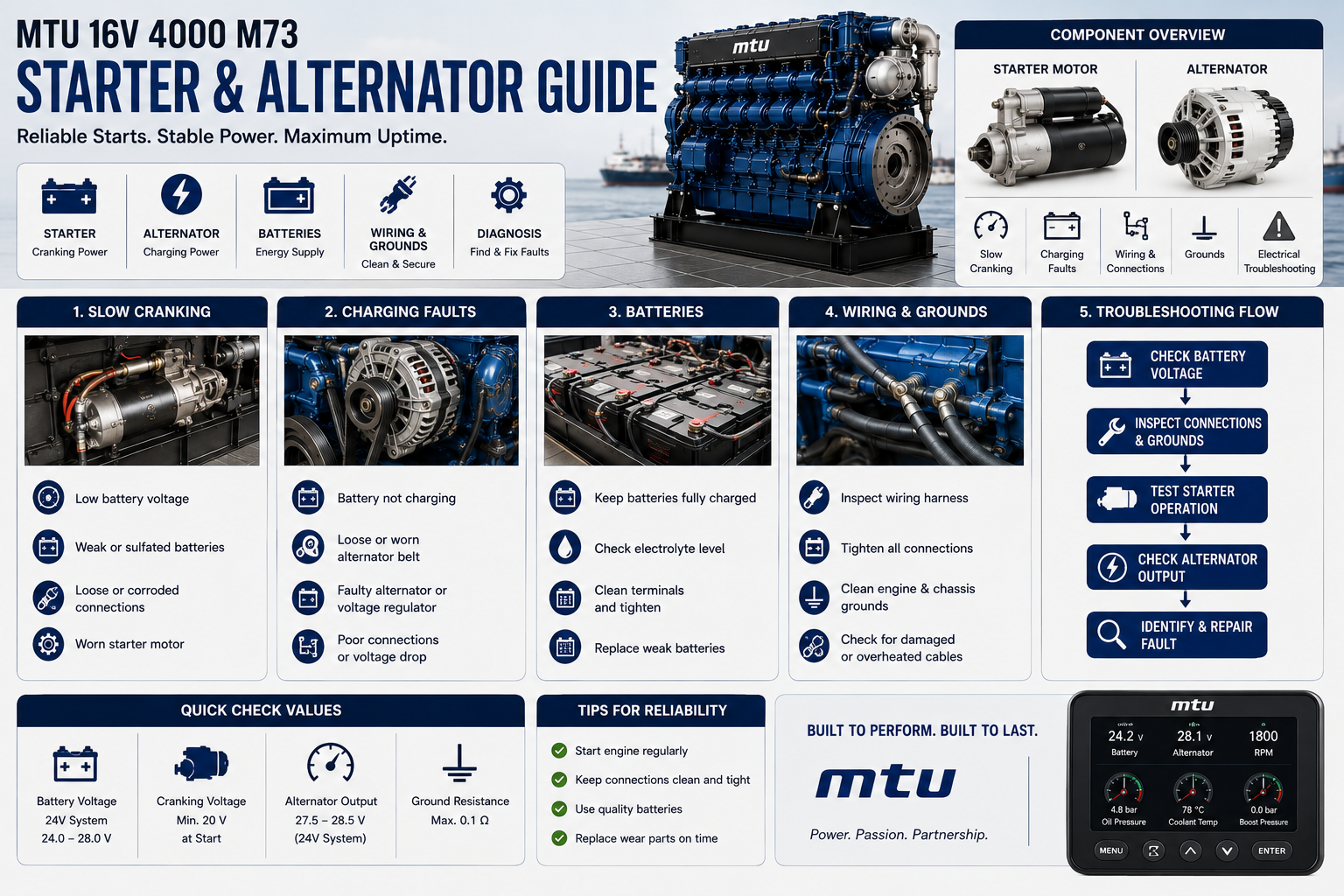
  • Starters & Alternators for MTU 16V 4000 M73 Marine Engines
  • 1. MTU 16V 4000 M73 Marine Engine
  • 2. What Does the Starter Motor Do?
  • 3. Why Starting a 16V 4000 Is Different From Starting a Small Marine Diesel
  • 4. The MTU Cranks Slowly
  • 5. Battery Voltage Can Look Good Until You Crank
  • 6. Voltage-Drop Testing
  • 7. Do Not Forget the Ground Side
  • 8. Starter Clicks but the MTU Does Not Crank
  • 9. Starter Does Absolutely Nothing
  • 10. Starter Works Sometimes
  • 11. Starter Works When Cold but Not When Hot
  • 12. Starter Motor Overheating
  • 13. What Can Cause Excessive Cranking?
  • 14. Starter Pinion and Ring Gear
  • 15. Grinding Noise During Starting
  • 16. Starter Spins but the Engine Does Not Turn
  • 17. What Does the Alternator Do?
  • 18. Why an Alternator Problem May First Look Like a Battery Problem
  • 19. Signs of Alternator or Charging Problems
  • 20. Alternator Output Should Be Checked Under Real Conditions
  • 21. Low Charging Voltage
  • 22. Alternator Produces No Charge
  • 23. Alternator Drive Condition
  • 24. Alternator Bearing Noise
  • 25. Alternator Overheating
  • 26. Oil and Coolant Contamination
  • 27. Saltwater Is Particularly Dangerous
  • 28. Wiring Harnesses Matter
  • 29. Turbochargers and Electrical Components
  • 30. Exhaust Leaks Can Damage Electrical Components
  • 31. Twin MTU 16V 4000 M73 Engines Give You a Useful Reference
  • 32. Compare Alternator Performance Between Engines
  • 33. Hot Battery Cables Are a Warning Sign
  • 34. Batteries Are Part of the Starting System
  • 35. Repeated Dead Batteries Need a Cause
  • 36. Starting Problems After Maintenance
  • 37. Problems After Starter Replacement
  • 38. Problems After Alternator Replacement
  • 39. Starter & Alternator Parts Should Not Be Ordered Only by Engine Family
  • 40. Why the MTU Engine Serial Number Matters
  • 41. Starter Identification
  • 42. Alternator Identification
  • 43. Starter and Alternator Inspection Checklist
  • 44. Common MTU 16V 4000 M73 Starting & Charging Parts
  • 45. Other Components Worth Checking
  • 46. Frequently Asked Questions
  • Why Does My MTU 16V 4000 M73 Crank Slowly?
  • Why Does the Starter Only Click?
  • Why Does the Starter Work Sometimes?
  • Why Are My Batteries Going Flat?
  • Can an Alternator Fail Without Stopping the Engine?
  • Can a Bad Ground Cause Slow Cranking?
  • Can a Starter Be Damaged by Cranking Too Long?
  • Should I Replace the Starter if the Engine Cranks Slowly?
  • Can an Exhaust Leak Damage Alternator Wiring?
  • What Information Is Needed to Order an MTU 4000 Starter or Alternator?
  • MTU Series 4000 Engine Types
  • MTU 16V 4000 M73 Marine Engine
  • Browse Our Complete Catalog
  • Contact Alfa Marine Spare Parts
  • Final Word
Read more
  • MTU 4000 Water Pumps: Part Numbers, Types & Marine Applications
  • 1. Water Pumps Used on MTU Series 4000 Engines
  • 2. MTU 4000 Water Pump X52620200081
  • 3. MTU 4000 Water Pump X52420300001
  • 4. MTU 16V4000 Seawater Pump X59420700008
  • 5. Common MTU Series 4000 Water Pump Components
  • 6. Signs an MTU 4000 Water Pump Needs Attention
  • 7. Why the MTU Engine Serial Number Matters
  • 8. MTU 4000 Water Pumps for Marine Maintenance
  • Request an MTU 4000 Water Pump Quote
  • Frequently Asked Questions
  • Are all MTU 4000 water pumps identical?
  • What is MTU part number X52620200081?
  • What is MTU part number X52420300001?
  • What application uses MTU part number X59420700008?
  • What information is required to order an MTU water pump?
Read more
  • Doosan Marine Engine Aftermarket Parts: L066, L086, L126, L136, V158, V180 & V222 Guide
  • Genuine vs Aftermarket Doosan Marine Engine Parts
  • Genuine Parts
  • OEM-Sourced Parts
  • Aftermarket Parts
  • Remanufactured Parts
  • Reconditioned Parts
  • When Can Aftermarket Doosan Marine Parts Be Used?
  • Physical Fit Alone Does Not Establish Technical Compatibility
  • Critical Doosan Engine Parts Require Greater Verification
  • Doosan L066TI Marine Engine Parts
  • Doosan L086TI Marine Engine Parts
  • Doosan L126TI Marine Engine Parts
  • Doosan L136, L136T & L136TI Marine Engine Parts
  • Doosan MD196T & MD196TI Marine Engine Parts
  • Doosan V158TI & 4V158TI Marine Engine Parts
  • Doosan V180TI Marine Engine Parts
  • Doosan V222TI & 4V222TI Marine Engine Parts
  • Why Doosan Marine Engine Duty Rating Matters
  • Do Not Ignore the Duty Rating
  • Why the Doosan Engine Serial Number Matters
  • What Is a Superseded Doosan Part Number?
  • Aftermarket Doosan Marine Engine Overhaul Kits
  • Aftermarket Doosan Fuel Injectors & Injection Pumps
  • Aftermarket Doosan Turbochargers
  • Aftermarket Pistons, Liners & Bearings
  • New Aftermarket vs Remanufactured vs Reconditioned
  • New Aftermarket
  • Remanufactured
  • Reconditioned
  • Common Mistakes When Ordering Doosan Marine Engine Parts
  • Ordering Only by Engine Family
  • Ignoring Model Suffixes
  • Ignoring the Duty Rating
  • Providing Horsepower Without Rated RPM
  • Assuming a Physically Identical Part Is Correct
  • Assuming All Aftermarket Parts Have the Same Quality
  • Ignoring the Number on the Removed Component
  • What Information Should You Provide When Ordering Doosan Parts?
  • Final Word
  • Browse Our Complete Catalog
  • Contact Alfa Marine Spare Parts
  • Doosan engine model + serial number + duty/rating + rated power/rpm + existing part number + quantity + photographs + delivery location.
Read more
  • Doosan L126TI Marine Engine Gauges: What Every Reading Can Tell You
  • 1. Which Engine Does This Guide Cover?
  • Doosan L126TI Marine Engine
  • 2. What Gauges Can You Find on a Doosan L126TI Marine Engine?
  • 3. Know What Normal Looks Like
  • 4. Engine RPM Gauge
  • 5. L126TI Cannot Reach Normal Loaded RPM
  • 6. RPM Drops Under Load
  • 7. Unstable RPM
  • 8. Oil Pressure Gauge
  • 9. Low Oil Pressure
  • 10. Oil Pressure Is Lower When the Engine Is Hot
  • 11. Sudden Oil Pressure Drop
  • 12. Coolant Temperature Gauge
  • 13. L126TI Runs Hot Only at High RPM
  • 14. Engine Overheats Soon After Leaving the Dock
  • 15. Temperature Slowly Creeps Higher Over Months
  • 16. Twin L126TI Engines Are Excellent for Comparison
  • 17. One Engine Runs Hotter Than the Other
  • 18. Boost Pressure Gauge
  • 19. Low Boost + Black Smoke
  • 20. Low Boost but No Smoke
  • 21. Turbocharger Problems Can Change Several Gauge Readings
  • 22. Intake and Charge-Air Temperature
  • 23. Fuel Pressure and Fuel-Supply Indicators
  • 24. Engine Runs Fine at Idle but Loses Power Underway
  • 25. Fuel Consumption
  • 26. Voltage Gauge
  • 27. Low Voltage During Starting
  • 28. Engine Hour Meter
  • 29. Exhaust Temperature Monitoring
  • 30. One Cylinder Is Hotter Than the Others
  • 31. One Cylinder Is Cooler
  • 32. All Exhaust Temperatures Rise
  • 33. Marine Gear Oil Pressure
  • 34. Marine Gear Temperature
  • 35. Raw-Water Pressure or Flow
  • 36. Alarm Lights and Warning Indicators
  • 37. Do Not Assume Every Alarm Means a Bad Sensor
  • 38. Gauge Problems Can Be Electrical Problems
  • 39. Check Connections Before Replacing Expensive Components
  • 40. Use Several Gauges Together
  • Situation A
  • Situation B
  • Situation C
  • Situation D
  • Situation E
  • 41. Hull Fouling Can Change Engine Readings
  • 42. Propeller Fouling Can Have the Same Effect
  • 43. Over-Pitched Propeller
  • 44. Engine-Room Ventilation Can Affect Readings
  • 45. Gauge Changes After Maintenance Work
  • After Cooling-System Service
  • After Fuel-Filter Service
  • After Electrical Work
  • 46. Keep a Daily L126TI Gauge Log
  • 47. Record Data Under Similar Conditions
  • 48. What Is More Important: The Number or the Trend?
  • 49. Common Gauge-Related Spare Parts
  • 50. Related L126TI Engine Parts
  • 51. What Information Should You Send When Ordering Doosan L126TI Gauge or Sensor Parts?
  • 52. Frequently Asked Questions
  • What Are the Most Important Gauges on a Doosan L126TI?
  • Why Is My L126TI Oil Pressure Lower When Hot?
  • Why Does My L126TI Run Hot Only Under Load?
  • Why Is My L126TI Not Reaching Normal RPM?
  • Does Black Smoke Mean the Injectors Are Bad?
  • Can Low Boost Cause Black Smoke?
  • Can a Dirty Heat Exchanger Affect the Temperature Gauge?
  • Can Hull Fouling Affect Engine Gauges?
  • Can a Bad Sensor Create a False Alarm?
  • Should Twin L126TI Engines Have Exactly the Same Readings?
  • Doosan L126TI Marine Engine Gauge & Spare Parts
  • Browse Our Complete Catalog
  • Contact Alfa Marine Spare Parts
  • Final Word
Read more
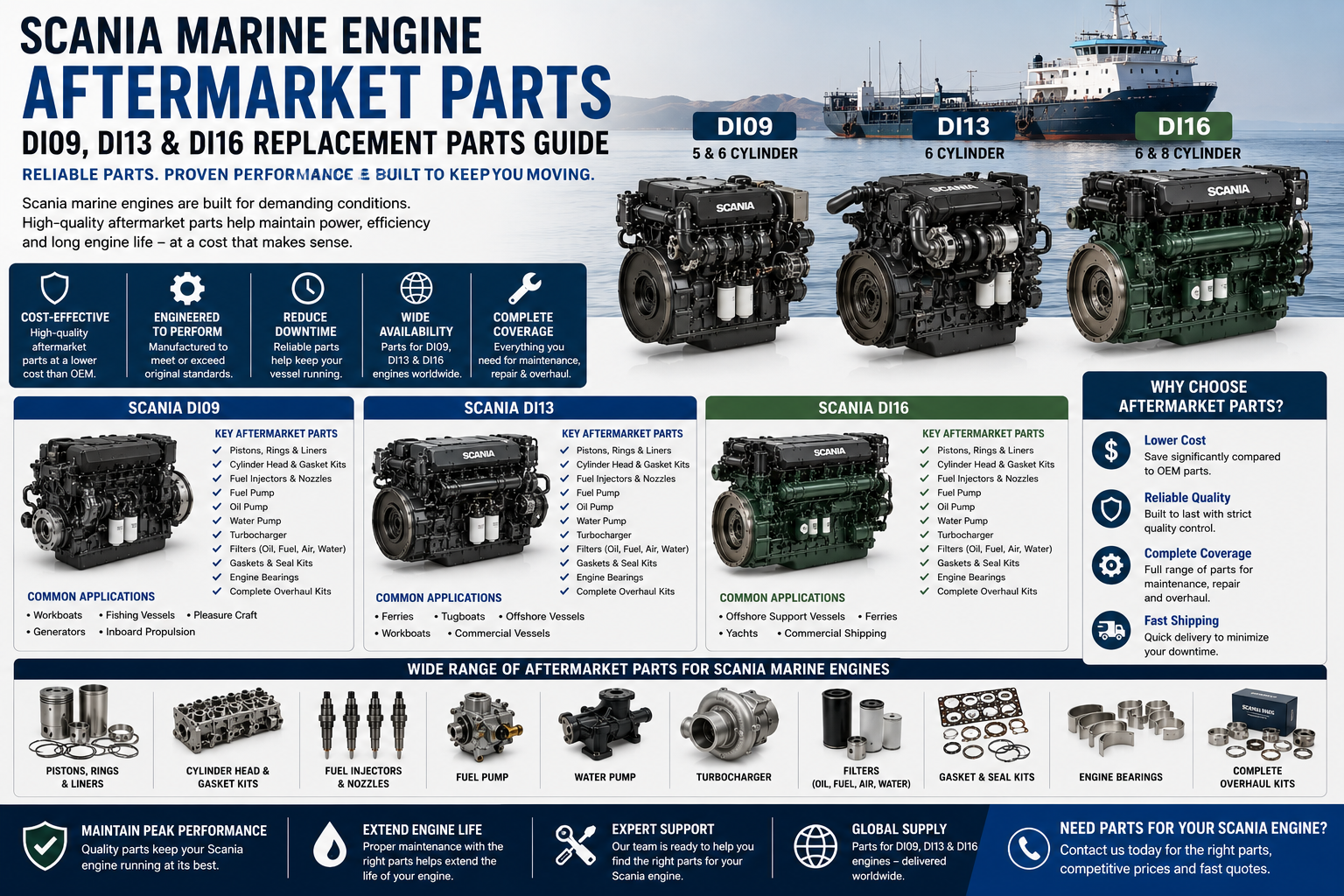
  • Scania Marine Engine Aftermarket Parts: DI09, DI13 & DI16 Replacement Parts Guide
  • 1. Which Scania Marine Engines Does This Guide Cover?
  • Scania DI09
  • Scania DI13
  • Scania DI16
  • 2. Scania DI09 Aftermarket Parts
  • 3. Scania DI13 Aftermarket Parts
  • 4. Scania DI16 Aftermarket Parts
  • 5. Aftermarket Scania Cylinder Heads
  • 6. Should You Rebuild or Replace a Scania Cylinder Head?
  • 7. Scania Marine Engine Overhaul Kits
  • 8. Why Scania Engine Serial Numbers Matter
  • 9. Scania Part Numbers: Don't Assume One Number Fits Every DI13 or DI16
  • 10. Aftermarket Scania Fuel Injectors
  • 11. New vs. Remanufactured Scania Injectors
  • 12. Scania High-Pressure Fuel Pumps
  • 13. Fuel Filters: Cheap Protection for Expensive Components
  • 14. Aftermarket Scania Turbochargers
  • 15. Rebuilding a Scania Turbocharger
  • 16. Scania Marine Freshwater Pumps
  • 17. Scania Marine Seawater Pumps
  • 18. Heat Exchangers
  • 19. Keel-Cooled Scania Engines Are Different
  • 20. Aftermarket Scania Oil Pumps
  • 21. Aftermarket Scania Pistons
  • 22. Scania Piston Rings
  • 23. Scania Cylinder Liners
  • 24. Liner Seals and O-Rings
  • 25. Main Bearings and Connecting-Rod Bearings
  • 26. Scania Connecting Rods
  • 27. Scania Crankshafts
  • 28. Full Scania Gasket Sets
  • 29. Scania Thermostats
  • Stuck Closed
  • Stuck Open
  • 30. Aftermarket Scania Sensors
  • 31. Scania Engine Control and Wiring Components
  • 32. Aftermarket Scania Oil Filters and Fuel Filters
  • 33. Starter Motors
  • 34. Alternators
  • 35. Which Scania Aftermarket Parts Are Lower Risk?
  • 36. When Should You Prefer Genuine or OEM?
  • 37. Best Scania Marine Spares to Keep Onboard
  • 38. How to Avoid Buying the Wrong Scania Marine Part
  • 39. Recommended Scania Aftermarket Parts Categories
  • Routine Maintenance
  • Cooling System
  • Fuel System
  • Air System
  • Internal Engine
  • Electrical
  • 40. Frequently Asked Questions
  • Are Aftermarket Parts Available for Scania Marine Engines?
  • Which Scania Marine Engine Families Are Most Common?
  • Can I Use Aftermarket Scania Injectors?
  • Can I Buy an Aftermarket Scania Turbocharger?
  • Can I Use an Aftermarket Scania Cylinder Head?
  • Are Scania DI13 and DI16 Parts Interchangeable?
  • Are Marine and Industrial Scania Parts the Same?
  • Can I Use Aftermarket Bearings?
  • Should I Buy a Complete Overhaul Kit?
  • What Information Is Needed for a Scania Parts Quote?
  • Scania Marine Engine Aftermarket Spare Parts
  • Browse Our Complete Catalog
  • Contact Alfa Marine Spare Parts
  • Final Word
Read more
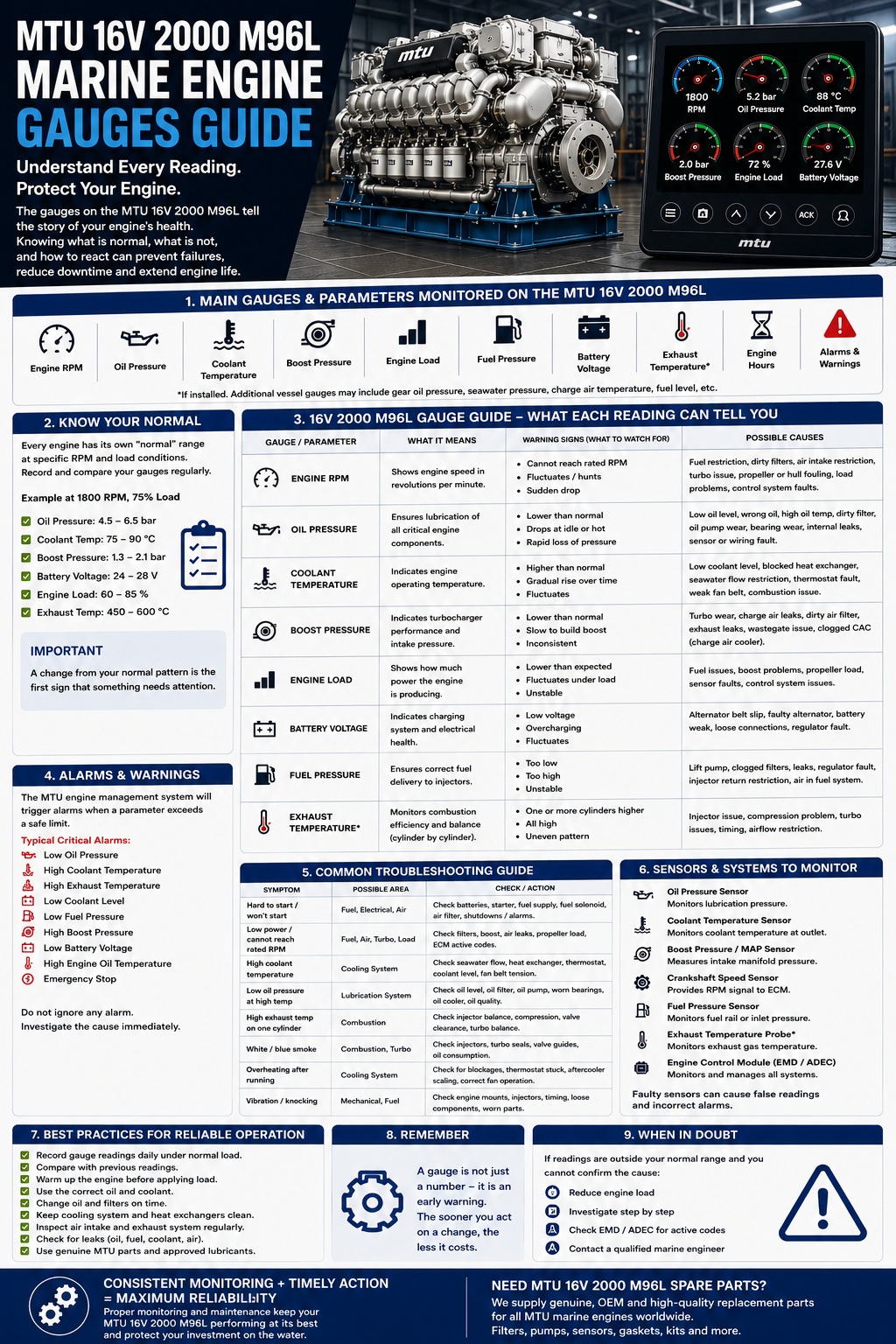
  • MTU 16V 2000 M96L Marine Engine Gauges: What Every Reading Can Tell You
  • 1. The MTU 16V 2000 M96L Marine Engine
  • 2. What Can Be Monitored on an MTU 16V 2000 M96L?
  • 3. Know Your Normal MTU Readings
  • 4. Engine RPM
  • 5. MTU Cannot Reach Normal Loaded RPM
  • 6. High Engine Load + Low Vessel Speed
  • 7. Engine Oil Pressure
  • 8. What Can Cause Low Oil Pressure?
  • 9. Sudden Oil Pressure Drop
  • 10. Oil Pressure and Oil Temperature Belong Together
  • 11. Engine Oil Temperature
  • 12. Coolant Temperature
  • 13. MTU Runs Hot Only at High Load
  • 14. Slowly Increasing Coolant Temperature
  • 15. Twin MTU 16V 2000 M96L Engines Are Useful Diagnostic References
  • 16. Charge-Air Pressure
  • 17. Low Boost + Increased Smoke
  • 18. Charge-Air Temperature
  • 19. Why Charge-Air Cooling Matters
  • 20. Turbocharger Monitoring
  • 21. Listen to the Turbochargers Too
  • 22. Fuel-Related Parameters
  • 23. Fuel Problems Often Appear Under Load First
  • 24. Fuel Consumption
  • 25. Port vs. Starboard Fuel Consumption
  • 26. Exhaust Temperature
  • 27. One Bank Runs Hotter
  • 28. All Exhaust Temperatures Rise
  • 29. Electrical System Voltage
  • 30. Engine Hours
  • 31. Engine Load
  • 32. Why Vessel Load Matters
  • 33. Hull Fouling
  • 34. Propeller Fouling
  • 35. Marine Gear Pressure
  • 36. Marine Gear Temperature
  • 37. Seawater Pressure or Flow
  • 38. Warning Messages
  • 39. Warning vs. Engine Protection
  • 40. Never Assume "It's Just a Sensor"
  • 41. Sensor and Wiring Problems
  • 42. Gauge Problems Immediately After Maintenance
  • 43. Abnormal Readings After Turbocharger Work
  • 44. Abnormal Readings After Fuel-System Work
  • 45. Use Several Parameters Together
  • Situation 1
  • Situation 2
  • Situation 3
  • Situation 4
  • Situation 5
  • 46. Keep an MTU 16V 2000 M96L Operating Log
  • 47. Why Trends Are So Valuable
  • 48. Do Not Compare Different Operating Conditions
  • 49. Common MTU Gauge and Monitoring-Related Components
  • 50. A Gauge Reading Can Lead to a Mechanical Repair
  • 51. Information Needed When Ordering MTU 16V 2000 M96L Parts
  • 52. Frequently Asked Questions
  • What Are the Most Important Gauges on an MTU 16V 2000 M96L?
  • Why Is My MTU Oil Pressure Lower When Hot?
  • Why Does My 16V 2000 M96L Run Hot Only at High Speed?
  • Why Is Boost Pressure Lower Than Before?
  • Can a Dirty Charge-Air Cooler Affect Performance?
  • Can Hull Fouling Affect MTU Engine Readings?
  • Should Twin MTU Engines Have Exactly the Same Readings?
  • Can a Sensor Cause a False Alarm?
  • Can Low Voltage Affect Engine Monitoring?
  • Should I Record Gauge Readings?
  • MTU 16V 2000 M96L Gauge & Engine Spare Parts
  • Browse Our Complete Catalog
  • Contact Alfa Marine Spare Parts
  • Final Word
Read more
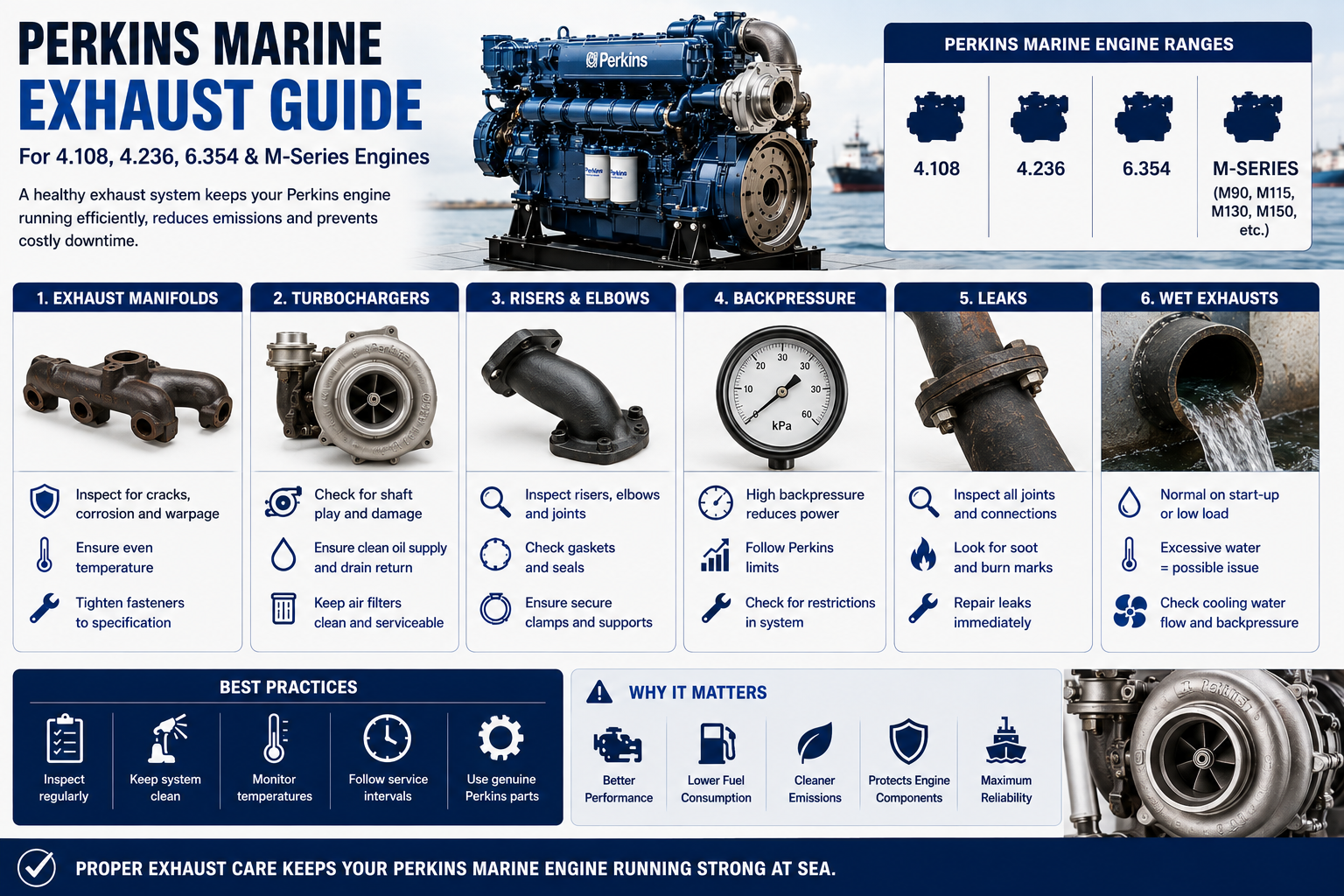
  • Perkins Marine Engine Exhaust Systems: Manifolds, Turbochargers, Risers, Elbows, Leaks & Troubleshooting
  • 1. Perkins Marine Engine Types Covered in This Guide
  • Smaller Perkins Marine Engines
  • Perkins 6-Cylinder & Legacy Marine Engines
  • Perkins Sabre / M-Series Marine Engines
  • Newer Perkins Auxiliary Marine Engines
  • 2. What Does a Perkins Marine Exhaust System Do?
  • 3. Why Exhaust Backpressure Matters
  • 4. Situation: The Perkins Engine No Longer Reaches Normal RPM
  • 5. Perkins Exhaust Manifolds
  • 6. Common Exhaust Manifold Problems
  • 7. Black Soot Around the Exhaust Manifold
  • 8. Why a Leak Before the Turbocharger Matters
  • 9. Exhaust Leaks Increase Engine-Room Heat
  • 10. Perkins 4.108 Exhaust System
  • 11. Perkins 4.236 Exhaust System
  • 12. Perkins 6.354 Marine Exhaust System
  • 13. Perkins M65 Exhaust System
  • 14. Perkins M85T Exhaust System
  • 15. Perkins M92 & M92B Exhaust Systems
  • 16. Perkins M115T Exhaust System
  • 17. Perkins M130C & M135 Exhaust Systems
  • 18. Perkins M150Ti Exhaust System
  • 19. Perkins M185C Exhaust System
  • 20. Perkins M215C & M225Ti Exhaust Systems
  • 21. Perkins M250C & M300C Exhaust Systems
  • 22. Perkins M265Ti & M300Ti Exhaust Systems
  • 23. Perkins E44 & E70 Marine Exhaust Systems
  • 24. What Is a Wet Exhaust System?
  • 25. The Biggest Wet-Exhaust Risk: Water Returning Toward the Engine
  • 26. Exhaust Riser Problems
  • 27. Exhaust Elbows
  • 28. What Does a Restricted Exhaust Elbow Feel Like?
  • 29. Water Injection Can Become Restricted Too
  • 30. Wet Exhaust Hose Problems
  • 31. Internal Hose Delamination
  • 32. Exhaust Hose Clamps
  • 33. Waterlock / Muffler Problems
  • 34. Dry Exhaust Systems
  • 35. Expansion Joints
  • 36. Exhaust Insulation
  • 37. Situation: Engine Room Is Hotter Than Normal
  • 38. Situation: You Smell Exhaust in the Engine Room
  • 39. Situation: Black Smoke Under Load
  • 40. Situation: Blue Smoke
  • 41. Situation: White Smoke
  • 42. Exhaust Backpressure Testing
  • 43. Why Backpressure Can Increase Over Time
  • 44. Exhaust Problems After Repowering
  • 45. Water Backflow After Engine Shutdown
  • 46. What Happens if Water Enters a Cylinder?
  • 47. Corrosion After Water Ingress
  • 48. Turbocharger & Exhaust System Relationship
  • 49. Turbocharger Damage From Foreign Material
  • 50. Fuel Injectors Influence Exhaust Temperature
  • 51. Exhaust Valve Problems
  • 52. Propeller Overload Can Look Like Exhaust Trouble
  • 53. Hull Fouling
  • 54. Daily Exhaust-System Checks
  • 55. Keep Exhaust Components Clean Enough to Inspect
  • 56. Maintenance Depends on the Exact Perkins Engine
  • 57. Common Perkins Marine Exhaust Spare Parts
  • 58. Other Perkins Parts Often Checked During Exhaust Troubleshooting
  • 59. What Information Should You Send When Ordering Perkins Exhaust Parts?
  • 60. Frequently Asked Questions
  • Can a Restricted Perkins Exhaust Cause Loss of Power?
  • Why Is There Black Soot Around My Perkins Exhaust Manifold?
  • Can a Bad Exhaust Elbow Cause Black Smoke?
  • Can a Perkins Exhaust Elbow Corrode Internally?
  • Can Seawater Enter a Perkins Engine Through the Exhaust?
  • What Should I Do if I Suspect Water Has Entered the Engine?
  • Can an Exhaust Leak Reduce Turbo Boost?
  • Can Exhaust Hose Deteriorate Internally?
  • Does High Exhaust Temperature Always Mean a Blocked Exhaust?
  • What Information Is Needed for Perkins Exhaust Parts?
  • Perkins Marine Engine Types
  • Perkins Marine Exhaust & Engine Spare Parts
  • Browse Our Complete Catalog
  • Contact Alfa Marine Spare Parts
  • Final Word
Read more
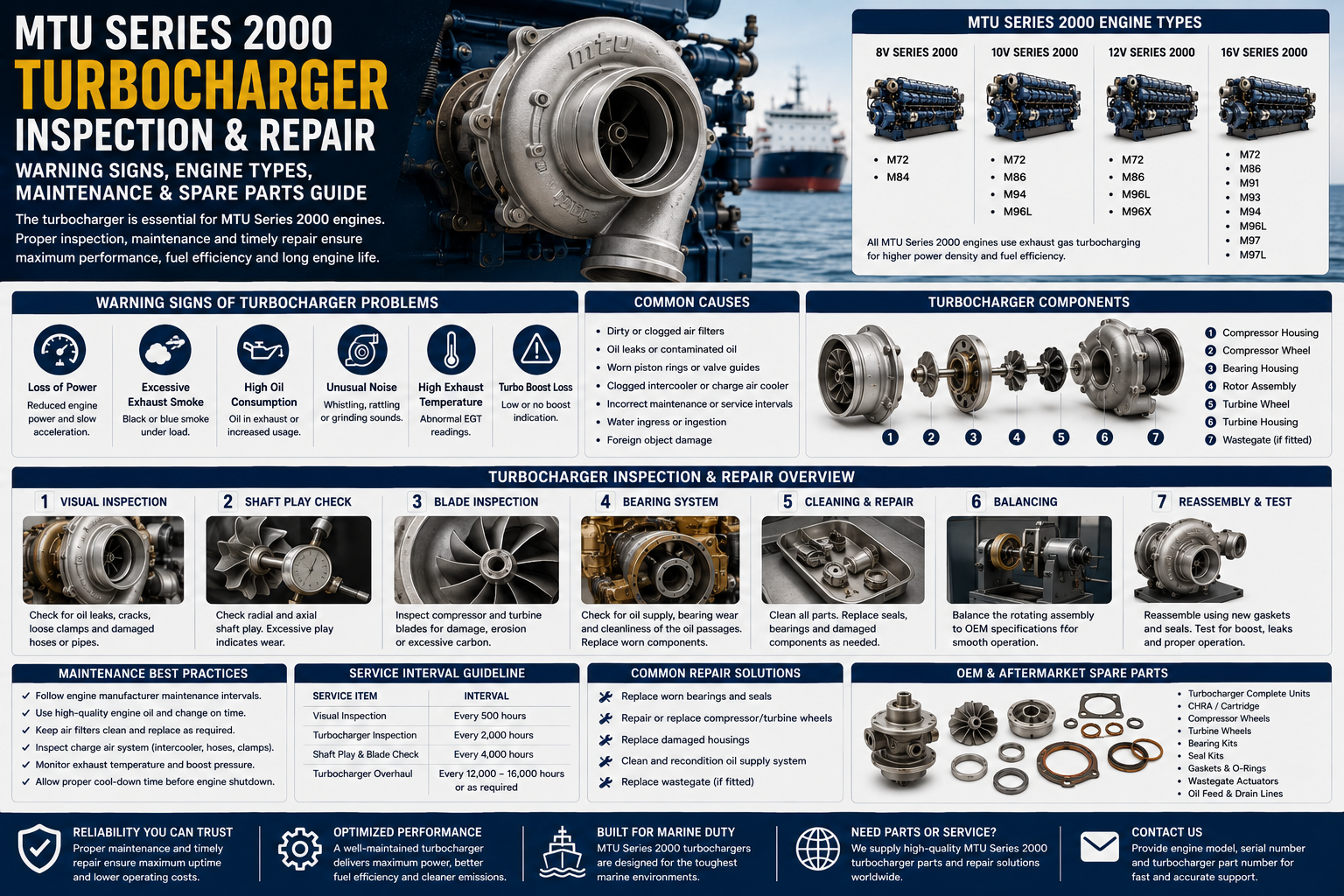
  • MTU Series 2000 Turbocharger Inspection & Repair: Warning Signs, Engine Types, Maintenance & Spare Parts Guide
  • 1. Which MTU Series 2000 Marine Engines Does This Guide Cover?
  • MTU 8V 2000
  • MTU 10V 2000
  • MTU 12V 2000
  • MTU 16V 2000
  • 2. What Does the Turbocharger Actually Do?
  • 3. Why Turbocharger Condition Matters So Much on an MTU 2000
  • 4. Situation: The MTU 2000 Suddenly Produces Black Smoke
  • 5. Situation: The Engine Feels Slow to Accelerate
  • 6. Situation: Boost Pressure Is Lower Than Normal
  • 7. Situation: Exhaust Temperature Is Increasing
  • 8. Situation: One Bank Behaves Differently
  • 9. Listen to the Turbocharger
  • 10. Inspect for Oil Around the Turbocharger
  • 11. Why Turbocharger Lubrication Is Critical
  • 12. Never Install a Replacement Turbo Without Checking the Oil Lines
  • 13. Compressor-Side Inspection
  • 14. What Can Damage the Compressor Wheel?
  • 15. Turbine-Side Inspection
  • 16. Carbon Deposits and Fouling
  • 17. Shaft Play: What Should You Look For?
  • 18. Never Spin or Handle the Turbocharger Carelessly
  • 19. Charge-Air Cooler Problems Can Look Like Turbo Problems
  • 20. Charge-Air Leaks
  • 21. Exhaust Leaks Before the Turbocharger
  • 22. Air Filters Matter Too
  • 23. Propeller Overload Can Make the Turbocharger Look Bad
  • 24. Twin MTU 2000 Engines Give You a Useful Comparison
  • 25. Inspect the Turbocharger During Routine Engine-Room Checks
  • 26. Keep the Turbocharger Area Clean
  • 27. When Should an MTU 2000 Turbocharger Be Repaired?
  • 28. What Happens During a Professional Turbocharger Inspection?
  • 29. Rebuild or Replace the Turbocharger?
  • Rebuilding May Make Sense When:
  • Replacement May Make More Sense When:
  • 30. Be Careful With Cheap Replacement Turbochargers
  • 31. Always Identify the Existing Turbocharger Number
  • 32. Don't Forget the Engine Serial Number
  • 33. Why Previous Overhauls Matter
  • 34. Turbocharger Failure Can Be the Result of Another Engine Problem
  • 35. What to Check After a Turbocharger Failure
  • 36. Foreign-Object Damage Requires Investigation
  • 37. Warning Signs That Deserve Quick Attention
  • 38. Common MTU 2000 Turbocharger-Related Spare Parts
  • 39. Other MTU Series 2000 Parts Often Checked During Turbo Repair
  • 40. Information to Send When Ordering MTU 2000 Turbocharger Parts
  • 41. Frequently Asked Questions
  • What Are the Main MTU Series 2000 Marine Engine Configurations?
  • Does Every MTU 2000 Use the Same Turbocharger?
  • Can an MTU 2000 Turbocharger Be Rebuilt?
  • Does Black Smoke Mean the Turbocharger Is Bad?
  • Can a Dirty Charge-Air Cooler Reduce Turbo Performance?
  • Can Low Oil Pressure Damage the Turbocharger?
  • Should I Replace Both Turbochargers If Only One Has a Problem?
  • Should I Replace the Turbocharger if Boost Is Low?
  • What Information Do I Need to Order an MTU 2000 Turbocharger?
  • MTU Series 2000 Marine Engine Types
  • 8V Series
  • 10V Series
  • 12V Series
  • 16V Series
  • MTU Series 2000 Turbocharger & Engine Spare Parts
  • Browse Our Complete Catalog
  • Contact Alfa Marine Spare Parts
  • Final Word
Read more
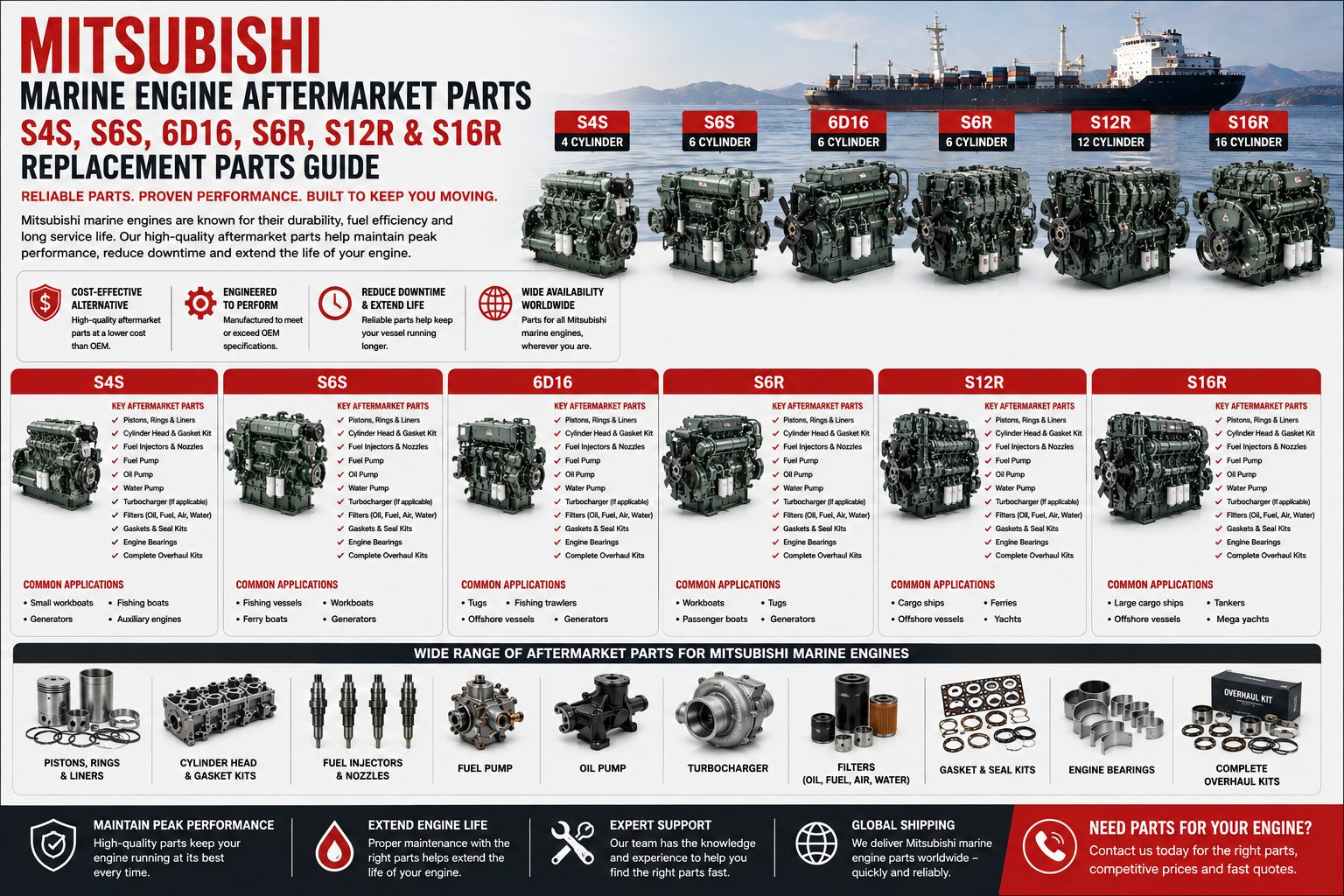
  • Mitsubishi Marine Engine Aftermarket Parts: S4S, S6S, 6D16, S6R, S12R & S16R Replacement Parts Guide
  • 1. Which Mitsubishi Marine Engines Does This Guide Cover?
  • Mitsubishi S4S
  • Mitsubishi S6S
  • Mitsubishi 6D16
  • Mitsubishi 6D24
  • Mitsubishi S6R
  • Mitsubishi S6R2
  • Mitsubishi S12R
  • Mitsubishi S16R
  • 2. Mitsubishi S4S Aftermarket Parts
  • 3. Mitsubishi S6S Aftermarket Parts
  • 4. Mitsubishi 6D16 Aftermarket Parts
  • 5. Mitsubishi 6D24 Aftermarket Parts
  • 6. Mitsubishi S6R Marine Engine Aftermarket Parts
  • 7. Mitsubishi S6R2 Aftermarket Parts
  • 8. Mitsubishi S12R Aftermarket Parts
  • 9. Mitsubishi S16R Aftermarket Parts
  • 10. Mitsubishi Aftermarket Cylinder Heads
  • 11. Rebuild or Replace a Mitsubishi Cylinder Head?
  • 12. Mitsubishi Marine Overhaul Kits
  • 13. Mitsubishi Part Numbers: Always Verify Before Ordering
  • 14. Example Mitsubishi Part Number Practice
  • 15. Aftermarket Mitsubishi Fuel Injectors
  • 16. New vs. Reconditioned Mitsubishi Injectors
  • 17. Mitsubishi Injection Pumps
  • 18. Fuel Feed Pumps
  • 19. Fuel Filters
  • 20. Aftermarket Mitsubishi Turbochargers
  • 21. Rebuilding a Mitsubishi Turbocharger
  • 22. Freshwater Pumps
  • 23. Seawater Pumps on Mitsubishi Marine Engines
  • 24. Heat Exchangers
  • 25. Aftermarket Oil Pumps
  • 26. Mitsubishi Pistons
  • 27. Mitsubishi Piston Rings
  • 28. Mitsubishi Cylinder Liners
  • 29. Main Bearings and Connecting-Rod Bearings
  • 30. Mitsubishi Connecting Rods
  • 31. Mitsubishi Crankshafts
  • 32. Full Mitsubishi Gasket Sets
  • 33. Mitsubishi Thermostats
  • 34. Mitsubishi Starters
  • 35. Mitsubishi Alternators
  • 36. Which Mitsubishi Aftermarket Parts Are Lower Risk?
  • 37. When Should You Prefer Genuine or OEM-Quality Parts?
  • 38. Best Mitsubishi Marine Spares to Keep Onboard
  • 39. How to Avoid Buying the Wrong Mitsubishi Marine Part
  • 40. Recommended Mitsubishi Aftermarket Parts Categories
  • Routine Maintenance
  • Cooling System
  • Fuel System
  • Air System
  • Internal Engine
  • Electrical
  • 41. Frequently Asked Questions
  • Are Aftermarket Parts Available for Mitsubishi Marine Engines?
  • Can I Use Aftermarket Mitsubishi Injectors?
  • Can Mechanical Mitsubishi Injection Pumps Be Rebuilt?
  • Can I Use an Aftermarket Mitsubishi Cylinder Head?
  • Can I Use Aftermarket Pistons and Liners?
  • Are S6R and S6R2 Parts the Same?
  • Are S12R and S16R Parts Interchangeable?
  • Can I Use Aftermarket Bearings?
  • Should I Buy a Complete Mitsubishi Overhaul Kit?
  • Mitsubishi Marine Engine Aftermarket Spare Parts
  • Browse Our Complete Catalog
  • Contact Alfa Marine Spare Parts
  • Final Word
Read more
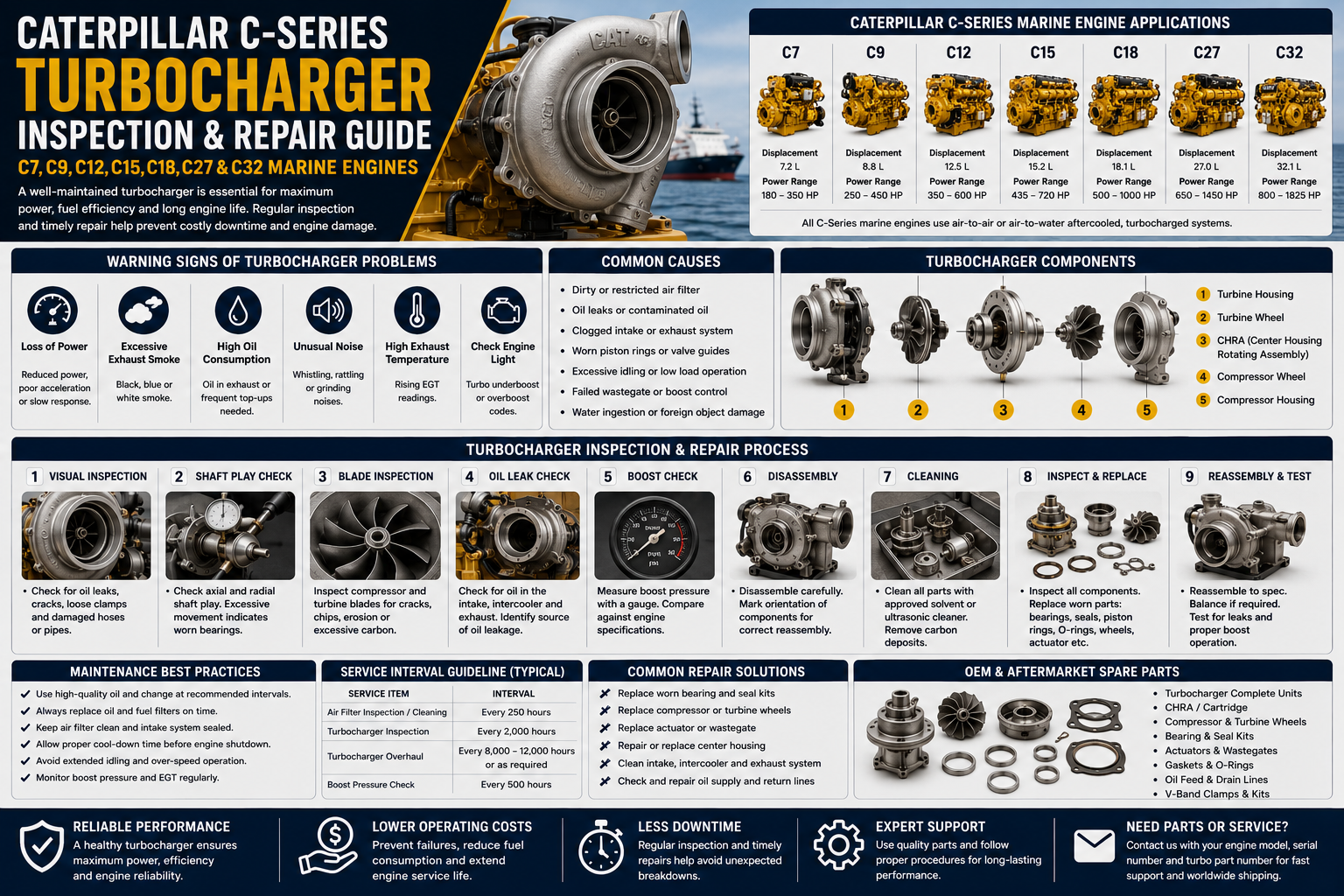
  • Caterpillar C-Series Turbocharger Inspection & Repair: C7, C9, C12, C15, C18, C27 & C32 Marine Engines
  • 1. Which Caterpillar C-Series Marine Engines Does This Guide Cover?
  • Caterpillar C4.4
  • Caterpillar C7 / C7.1
  • Caterpillar C9 / C9.3
  • Caterpillar C12
  • Caterpillar C15
  • Caterpillar C18
  • Caterpillar C27
  • Caterpillar C32
  • Caterpillar C32B
  • 2. Why the Exact Caterpillar C-Series Engine Matters
  • 3. What Does a Caterpillar Marine Turbocharger Actually Do?
  • Turbine Side
  • Compressor Side
  • 4. Why Turbocharger Performance Matters
  • 5. Situation: The Caterpillar Marine Engine Starts Producing Black Smoke
  • 6. Situation: The Engine Has Lost Acceleration
  • 7. Situation: Boost Pressure Is Lower Than Normal
  • 8. Situation: Exhaust Temperature Starts Increasing
  • 9. Situation: One Engine Behaves Differently From the Other
  • 10. Listen for Changes in Turbocharger Noise
  • 11. Scraping or Rubbing Noise Is More Serious
  • 12. Oil Around the Turbocharger
  • 13. Why Lubrication Is Critical
  • 14. Never Install a New Turbo Onto a Blocked Oil Supply
  • 15. Compressor-Wheel Inspection
  • 16. What Causes Compressor-Wheel Damage?
  • 17. Turbine-Wheel Inspection
  • 18. Carbon Deposits
  • 19. Turbocharger Shaft and Bearing Inspection
  • 20. Aftercooler Problems Can Look Like Turbocharger Problems
  • 21. Charge-Air Leaks
  • 22. Oil Mist Around a Charge-Air Connection
  • 23. Exhaust Leaks Before the Turbocharger
  • 24. Air-Filter Restriction
  • 25. Propeller Overload Can Look Like Turbocharger Trouble
  • 26. Hull Fouling Can Also Affect Turbo Performance
  • 27. Caterpillar C7 / C7.1 Turbocharger Inspection
  • 28. Caterpillar C9 / C9.3 Turbocharger Inspection
  • 29. Caterpillar C12 Turbocharger Inspection
  • 30. Caterpillar C15 Turbocharger Inspection
  • 31. Caterpillar C18 Turbocharger Inspection
  • 32. Caterpillar C27 Turbocharger Inspection
  • 33. Caterpillar C32 Turbocharger Inspection
  • 34. Caterpillar C32B Turbocharger Parts Are Not Automatically C32 Parts
  • 35. When Should a Caterpillar Marine Turbocharger Be Rebuilt?
  • 36. What Happens During Professional Turbocharger Repair?
  • 37. Rebuild or Replace?
  • Rebuild May Make Sense When:
  • Replacement May Make More Sense When:
  • 38. New vs. Remanufactured Turbocharger
  • 39. Be Careful With Very Cheap Turbochargers
  • 40. Why the Turbocharger Part Number Matters
  • 41. Why the Caterpillar Serial Number Matters
  • 42. Inspect the Turbocharger After an Engine Failure
  • 43. What to Check After a Turbocharger Failure
  • 44. Foreign-Object Damage
  • 45. Turbocharger Maintenance Starts With Engine Oil
  • 46. Warm-Up Matters
  • 47. Cool-Down After Heavy Operation
  • 48. Keep an Operating Baseline
  • 49. Compare Similar Conditions
  • 50. Warning Signs That Deserve Investigation
  • 51. Common Caterpillar C-Series Turbocharger Spare Parts
  • 52. Related Caterpillar Air-System Parts
  • 53. Caterpillar Fuel Injectors and Turbocharger Performance
  • 54. Sensors Can Also Create Misleading Turbocharger Symptoms
  • 55. Frequently Asked Questions
  • Which Caterpillar C-Series Marine Engines Use Turbochargers?
  • Does Every Caterpillar C-Series Engine Use the Same Turbo?
  • Does Black Smoke Mean the Turbo Is Bad?
  • Can a Dirty Aftercooler Cause Low Power?
  • Can an Exhaust Leak Cause Low Boost?
  • Can Low Oil Pressure Damage the Turbocharger?
  • Can a Caterpillar Turbocharger Be Rebuilt?
  • Should I Replace the Turbo if Boost Is Low?
  • Should Both Turbos Be Replaced Together?
  • What Information Do I Need to Order a Caterpillar Turbocharger?
  • Caterpillar C-Series Marine Engine Types
  • Caterpillar C-Series Turbocharger & Marine Engine Spare Parts
  • Browse Our Complete Catalog
  • Contact Alfa Marine Spare Parts
  • Final Word
Read more
1 6 7 8 9 10 47